Monday, November 4, 2013

Western Time Diary: The Gold Rush Town of Columbia, California

The first word in my mind when arriving in the late evening in the former gold rush town of Columbia, California, was not gold. It was stars. I had never seen so many stars in my life, except for maybe the American Southwest.  There is so much light pollution in our congested northern New Jersey area, stars here were my gold dust in the night sky. 

We stayed at the Harlan House bed and breakfast, for adults only (unfortunately the owner had a few bad experiences with ill-behaved children). Families might want to check out the historic City Hotel or Fallon Hotel which was our next choice.

A front porch seems so inviting.


The rose room. Are there ghosts here? Do you believe in them? It seems like these old homes must have spirits.


Bonnets getting me in touch with my Laura Ingalls Wilder.


A beautiful cross stitch reminds us, "To love and be loved is the greatest joy on earth." I do believe this is indeed one of the greatest joys, but it doesn't have to be romantic love. It can be the love of a family member, cherished friend or pet.

Remember that Little House on the Prairie episode where the Ingalls and Edwards families tries their luck at panning for gold? Laura encounters an old man whose wife lay buried in the river, her grave robbed by hungry gold seekers.  Before her death, he always wanted more gold to buy her more things, but after he said everything he ever wanted was buried in the river. 


A breakfast scramble with hash browns, bread, fruit with jam, tea and juice. I adore a beautifully set breakfast table, accompanied by a pot of tea.


Right across the road from Harlan House is a trail leading up to a restored school house. This marker remembers a teacher Karen Bakerville Smith, who taught with the same effort toward excellence as the pioneer teachers. If you get the Hallmark Channel, you might enjoy (as I did) the adaption of When Calls the Heart, about pioneer schoolteachers, a film that is being developed into a series for 2014. In an age when so much of entertainment is shallow, I'm so glad original content is being produced showcasing teachers and the West. Who cares about the vapid lives of today's reality starlets or limited talented celebrities who can't get press without shedding their clothes? I'm so tired of hearing about them. These women's lives were far more interesting.

I like what the singer Tori Amos said, "Every day you wake up and say not,“What do I know?” but you wake up and say, “What can I learn today?” I learn so much from traveling.  We should all strive to continue learning.
 

I'm a little obsessed with old schoolhouses. Maybe I was a schoolteacher once in a past life?


""Gold" someone yelled above the noise of the river. "Miles north of Old Dry Creek!"

Suddenly the noise of picks and shovels stopped. Before our eyes was a swarm of men hurried out of camp to where their horses were grazing. They mounted and disappeared into the woods. Others packed tools and bedrolls onto their mules: some just started walking.

I was amazed at the power of that one word: gold." - Seeds of Hope: The Gold Rush Diary of Susanna Fairchild, California Territory 1849 by Kristiana Gregory, part of the Dear America series, an engaging fictional diary line introducing U.S. history to readers young and old.

Gold. It was on my mind for a few weeks before my wedding. I used my grandmother's engagement ring from the 1920s, but we needed wedding bands. My grandfather's didn't fit Steve and the engravings might have been jeopardized with stretching and I didn't favor the look of the yellow gold. I opted for a rose gold band for myself with tiny specks of diamonds. I asked about the origins, since I started reading H.W. Brands' "Age of Gold: The California Gold Rush and the New American Dream"  (a book I need to get back to). I quickly learned how hard it is to trace the origins of gold.

I thought about Brands' remark in an online lecture about how he was raised in Oregon and traveled with his father seeing parts of the Lewis and Clark trail, while his wife from Maryland thought in the context of the Civil War sites. A lifelong New Jerseyan, we have revolutionary war history reminders, and so often you'll see a plaque from the historical society retracing Washington's army's steps. His wife and I never thought much of the gold rush, which brought California to statehood in just two years and was one of the largest migrations of people since the Crusades, according to Brands.

It's easy to romanticize legions of people coming from all corners of the globe seeking riches, but there was so often a root of desperation bringing the 49rs there, and the aftermath was even darker. Journalist Chris Bowman noted,

"Opportunists swarming the Sierra Nevada like grasshoppers, rearranging its rivers and streams, choking them with mining debris, polluting them with everlasting mercury, scalping hillsides, denuding forests, overfishing, overhunting, overrunning meadows with livestock, introducing diseases, displacing native plants, ousting thousands of environmentally conscious American Indians and forever shattering the primeval stillness of the mountains...Undeterred by law or conscience, the 19th-century Argonauts simply helped themselves to billions of dollars' worth of Sierra gold."

The courts would take 35 years before imposing the first restraints on the hydraulic mining. Until then it was a free-for-all.  As historian David Beesley said simply,

"There's no evidence that anyone stood up for the mountains."

Read more here: http://www.calgoldrush.com/part4/04environment.html#storylink=cpy

Read more here: http://www.calgoldrush.com/part4/04environment.html#storylink=cpy


Read more here: http://www.calgoldrush.com/part4/04environment.html#storylink=cpy

Read more here: http://www.calgoldrush.com/part4/04environment.html#storylink=cpy
At the local bookseller, I spotted McGuffey readers. I can just hear Mrs. Beadle telling students to take these out on Little House on the Prairie. I read the readers emphasized spelling, vocabulary and public speaking which was more important in 19th century America than it is today. I think the beauty of the word isn't valued enough in our modern age.


I wondered about the lives of those pictured here.


Evangeline and Other Poems by Henry Wadsworth Longfellow, published in 1847. What will the popular storytellers of our times tell future generations?

 
The Columbia cemetery.  In a New York Times op-ed piece, "The Man Who Loves Cemeteries," author Allan Gurganus writes, "A novelist needs both a dictionary and a cemetery. Graveyards offer more than your eventual remaindered resting-shelf. Approached in the joyful spirit of mortal play, they provide historic bullet points, bird sanctuaries, excellent fictitious names, and the lifelong source of such sweet calm." I think many of his points could be true for non-novelists too.

In the cemetery that sits behind his North Carolina home, he aches "most for child brides perished in childbirth. One epitaph runs: “Mother — she did all she could.”


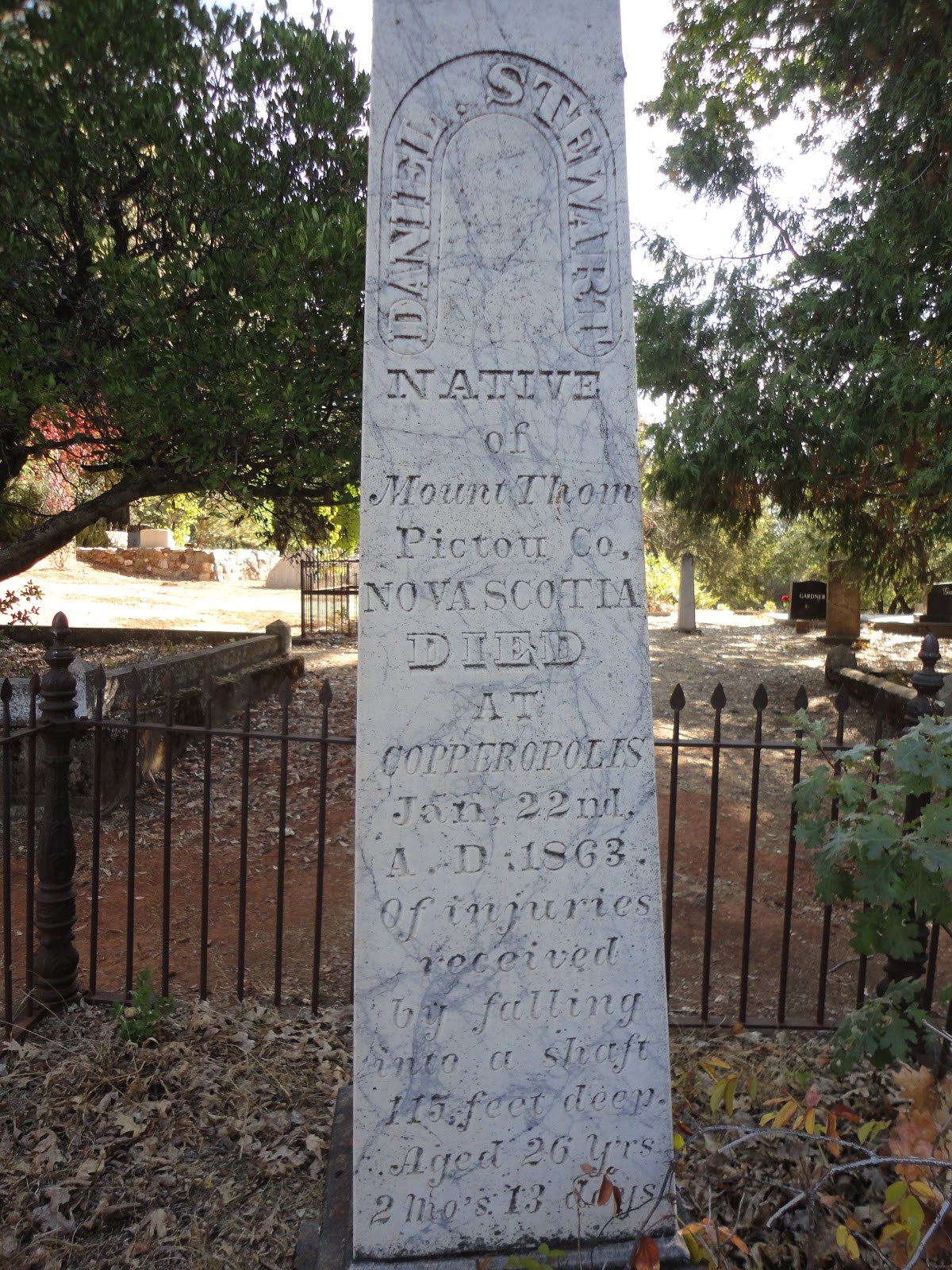
Here lies a soul who lost their life at 26 years of age from falling down a shaft. What's so striking walking through here is the short life spans. A few celebrities were in the news of late passing away in their seventies and the first thought I had was that seems so young, but in this time it would be ancient. Many gravestones marked not just years but days. Each day mattered.

This marker is in memory of the Chinese pioneers, whose remains were disinterred and returned to their homeland.


Natalie Merchant's rendition of Poor Wayfaring Stranger from The House Carpenter's Daughter folk album comes to mind when I stroll these old cemeteries. Despite how downtrodden the narrator is, I think of the comfort they find in going on to beautiful fields to meet "my mother, said she'd meet me when I come" and to see "my loved ones, gone on before me one by one."


"Who were the homestead wives who were the gold rush brides, does anyone know? Do their works survive their yellow fever lives in pages that they wrote," Ms. Merchant pondered in the 10,000 Maniacs songs Gold Rush Brides.


At the local bookshop, I picked up A Columbia Diary, the real life diary of Clementine Brainard, covering her life from 1853-1858. Clementine wrote in the first entry on October 19, 1853 of her intentions to keep journey during her sea journey but didn't. I brought a diary with me I had romantic notions of keeping during my trip, and alas was to exhausted at day's end. My blog is the closest thing I keep to a diary of my thoughts and memories.

Clementine writes, "Do I ever have any thoughts that are worth being transferred to paper? I must be a singular individual if I do not." Do you keep a diary?

Clementine recorded memories of her husband's frequent ill health, mail deliveries (but doesn't elaborate much about what's in the letters) and speaks matter-of-factly often when talking about death (maybe unsurprisingly seeing how common early death was). She bears her first child with barely any mention before and after the event. Clementine's husband dies at age 30 and she remarries and bears six more children, four of whom die in infancy.

So much is documented (arguably overly documented) in our digital age. Will these modern forms have the permanence though of the older forms of diaries and journals?

I needed some tea to ponder all of this. I read about Columbia Kate's teahouse doing trip research beforehand, and knew I would love it before I even set foot in it. I was right.


Their dining room was bustling, so we ate in their airy, cheerful screened patio.


Tea cups adorn each table with names of mines and claims.


An autumn feast of blackberry sage tea, pumpkin soup and an apricot scone with the trimmings. Love the tea cozy!


A Meyer lemon bar to share. I've loved blue and white dishes for ages. They always bring back memories of eating mashed potatoes in my grandparents' house in Switzerland as a child.


A Columbia welcome wagon. How welcoming this town did feel, and left me with so much to think about.


On the road to Yosemite next. Coming in to Columbia, we passed by a field of wind mills. How different this view was from what the gold seekers saw, and the preservation of the environment was on my mind again. Election Day is tomorrow, with as usual little mention of how the candidates plan to protect our air, oil and water supplies - the greatest gold we have. Our local paper had a section on where the gubernatorial candidates stood on the issues and unsurprisingly the environment did not make the list, even though issues like gambling did. This in spite of the fact that New Jersey has 113 active  toxic Superfund sites, the most in the nation, and a natural gas formation has been discovered in New Jersey, opening up the possibilities of fracking in my home state. I thought about all the harm the gold seekers did, intentionally or not, with no regulation or protections of our lands.
I'll be voting tomorrow for my own gold.


Sunday, October 27, 2013

Western Time Diary: The California Wine Country

"Can we turn around?" I asked Steve when we drove by this strawberry stand. One of the delights of the open rode is stumbling upon these farm stands.


This is my kind of fast food.


Our nifty Ford Focus.


Passing through Glen Ellen, we came across this book exchange inspired by the author Jack London. Some of my favorite books have found me because someone passed them on. I admit to getting greedy in recent years and wanting to hold onto some of my favorite storytellers but do share them. Do you keep books or pass them on?


Stories awaiting readers.


Many of my memories of the wine country weren't about the wine, but about the food and the scenery, much of it the gardens. Lunch at magnificent The Girl and the Fig. On the menu during our visit was this chickpea cake with local cheese and greens, and I had a non-alcoholic drink of rose water, mint, lime and cranberry juice.


Steve's vanilla bean cheesecake with apple and fig compote.


My lavender creme brulee.


Of the wineries we visited, Kendall Jackson was my favorite.


A sweet Riesling here while sampling dessert wines.


I could have lingered in their garden all day.


Tomatoes for sale.


Off to Korbel to sample some champagne.


Pink champagne. Cheers!


Despite having late lunch plans, I couldn't resist sampling their salads like the butternut squash and orzo with brie, raisins and basil with some crusty bread. I forced myself to not get the roasted red pepper bisque and peach blackberry tart to accompany it. I haven't eaten meat since I was a teenager and California offered a vegetarian bounty.


Lunch at the Wine Spectator restaurant at the Culinary Institute of America. You know I'm a chef's wife when I hear CIA I think of the culinary school and not the Central Intelligence Agency, although Steve is self-taught in the kitchen. We shared this sweet corn soup with avocado froth and blue corn tortillas sprinkles, pictured with my drink of jasmine tea, peach puree and ginger ale.

 
The vegetarian risotto. Another thing of note is the reasonable portion sizes. We don't care for restaurants who brag about their enormous portions. Gorging myself doesn't feel civilized, and I don't need leftovers for days.


Apple and pear sorbet.

Who knew one of my favorite storytellers from childhood would find me on my honeymoon? The Charles M. Schultz Museum is located in Santa Rosa.
 
I already looked up when they'll be televising Linus and his annual awaiting of the Great Pumpkin (you're never too old!) My sister and I still enjoy watching the Charlie Brown holiday specials each year, a small joy for sure. Snoopy savors the small things.


Skaters at Snoopy's Home Ice.


My Peppermint Patty hot chocolate at the Warm Puppy Cafe!


At a little food hall on the way to the next stop, a French creperie.

 
A honey almond crepe to share. Bees are so essential to the pollination of crops, including almonds. I'm thankful to the bees for this treat.


Lunch at Thomas Keller's Bouchon Bistro. Keller was involved with one of my favorite food films, Ratatouille, about a rat who becomes a great chef in Paris. As Remy's idol says, "Anyone can cook!"


A pear cider and to share the salad.


Toasted gnocchi with vegetables, including fennel.


Steve's brownie with peanut butter ice cream.


My ile flottante with salted caramel sauce.


No dinner for us at Keller's French Laundry. Our guidebook said reservations are needed months in advance and a meal could run $250 a person!

 
The garden of the French Laundry.
 
 
I let Steve (more the wine connoisseur) enjoy the wineries more while I did the driving, but I was just content to take in the scenery. Here enjoying a Vignette wine country soda in a rose flavor with roasted almonds at Domaine Carneros.
 
 
Steve and I considered, and even decided, on going to France for our honeymoon, but changed our minds. We've been to Paris, but not the countryside. I'm so glad we picked California. Our flight was a fraction of the price and the exchange rate was on our side. There's an endless stream of people writing books and blogs about going to France and finding the good life, but the good life is here to be savored too.

I also remember being in a small town in Spain (our first trips together included Paris, Switzerland, Mexico, Italy and then Spain), and thinking to myself, I want to see more of the United States on our next vacation. We toured the Southwest the next year, a trip I return to in my mind over and over again and remains one of my favorites, and we have built so many wonderful memories touring America.

Up next, a visit to a Gold Rush town, pondering the idea of riches.

Tuesday, October 22, 2013

Western Time Diary: Lands End and Muir Woods

Seeds. I've been thinking a lot about seeds, physically planting them and watching something grow with patience, nurturing and a hopeful heart, whether that be a child or a bed of morning glory, but seeds of ideas too. As a teenager, I used to have a picture of a young boy with a fish in an idyllic pond setting. I think it was from a Rolling Stone article on the fight to save Walden Woods back in the 1990s. There was a quote from Henry David Thoreau, "Heaven is under our feet as well as over our heads." That was one of the seeds that planted in me a desire to love and protect the environment. I ran track and cross country in high school and we'd run in a wooded area by a reservoir that reminded me of that scene from the article. It was such a sacred place. Another seed so many years ago that took root so firmly, opening my eyes to the natural world's wonders even in our own backyard.
 
Before I explored Lands End in San Francisco, I read over some of the letters visitors wrote here. So much of it was about connection. It broke my heart to read a New York Times article on the defacing of national parks by some who even boast about their actions on social media. These parks are sacred places.


Jean Craighead George, reflecting on her novel published in 1959, My Side of the Mountain, about Sam, a young boy who runs away from New York City life to live off of the land in the Catskill Mountains said,
 
"When I pick up this book again and look at it, I realize how far we've come from the sense of the earth and its importance. We're polluting streams. We're putting arsenic in water. We are killing the endangered species, and we do not understand how connected we are to all these things and we must protect them in order to live as a human being. We are part of them. Which I think in a way Sam did as he ate the plants and the animals of the wilderness and lived in a tree where no one would find him. That’s where I want to be."


Part of what I love so much about travel is that even if I'm some place for a few hours, or even a few moments, they stay imprinted in my memory bank for accessing times of calm and reflection. Two of those places for me in California were Lands End and Muir Woods. I have been at these places only once physically, but in spirit countless times.  Do these special places exist for you?
 

"I hear the trees whispering sometimes. They don't talk to everyone. Or maybe they do, but not everyone listens. Do you hear them?" - from J.J. Brown's Brindle 24, a cautionary tale about fracking, the process to extract natural gas.

 
"The perfumed walk is a mystical part of her world." - Brindle 24.
 

Remembering those who lived off of the land in harmony. The connection with the environment is one of the aspects that draws me to the Native American culture.
 
 
Visitors at Muir Woods are reminded life is always in motion.
 
 
 "See that falcon? Hear those white-throated sparrows? Smell that skunk? Well, the falcon takes the sky, the white-throated sparrow takes the low bushes, the skunk takes the earth...I take the woods." - My Side of the Mountain


"The ancient trees are the deep earth's language for speaking to the universe. The earth communicates through trees to the animals and the birds living above - and to the heavens. The trees draw the earth's water up from the ground. Then breathing, they return it to the air for the clouds and the blessed rain that falls to begin the cycle again. She thinks of the thin layer of living things as a fragile space between earth's molten rock core and the frozen outer universe of stars. The thin layer is like her own life here - precious, finite." - Brindle 24


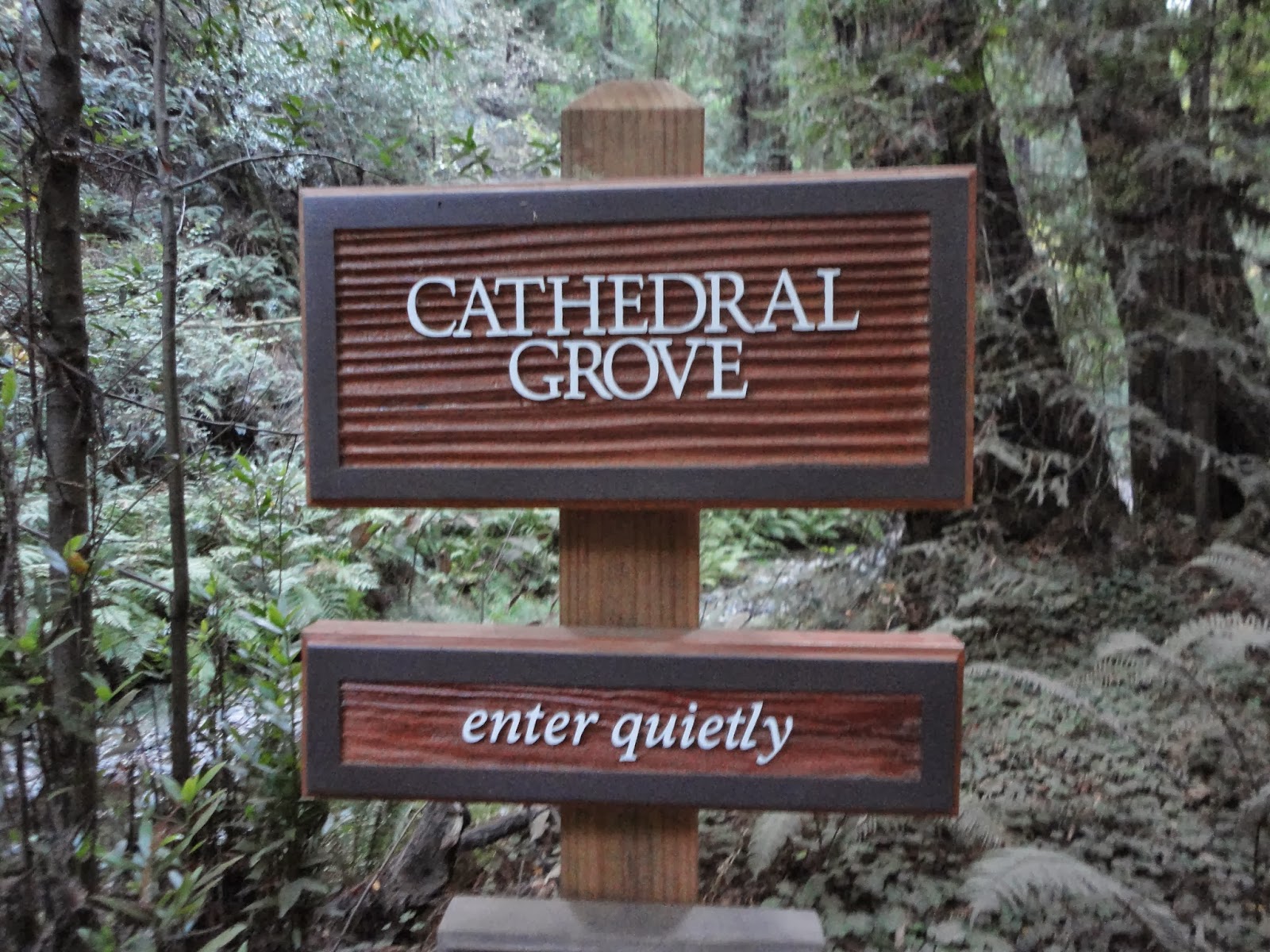
I couldn't think of a more fitting name. The grove did feel like a place of worship.
 
 
In Joanna L Stratton's book, "Pioneer Women: Voices from the Kansas Frontier," Lulu Fuhr observed,
 
"Pioneering is really wilderness experience. We all need the wisdom of the wilderness - Moses did, Jesus did, and Paul did. The wilderness is a place to find God, and the city is the place to study the multitude; a knowledge of both makes for master builders of state and nation."
 
I think our elected leaders should spend more time in these reserves of nature. A colleague returning from a trip to visit the parks in Montana was so moved by what he saw he declared it should be a requirement to go spend time in some of these parks.


Signs everywhere reminded visitors of their impact.
 
 
A godfather of the conservationist movement and Sierra Club founder John Muir. If you haven't already seen it, I highly recommend the Ken Burns documentary, "National Parks: America's Best Idea." I have a large postcard in my home office/library that I framed with Muir's advice:
 
Climb the mountains and get their good tidings.
Feast on sunlight.
Let go of your cares like autumn leaves.
Leave your legacy for the earth
Breath in nature's peace and get their good tidings.
 
 
Sharing one of my favorite poems on trees, by J.J. Brown in her novel American Dream. I feel a bit of Muir's spirit in this work.

“If he could go back in time to when Mother was a child and protect her invisibly throughout her life, he was sure that he would do it. He tried to compose a poem for her during the long ride back.

Let me be a tree.
Let me be the locust tree
her dear hands clasp as a child
where she looks up
as if I were her eternity
And give me a coat of ribbed tree bark
for her to carve her ABC’s.


Let me be a thousand locust blossoms
to perfume her walk in spring
but keep her from the poison seeds
that scatter where she plays.

Or let me be the maple tree
her strong hands tap in spring
and the flowing golden syrup in her glass
then shed the crimson leaves
to line her walk in autumn.

Yes, let me be a tree.
But let me not be hacked into logs
not planed smooth and drowned in stains
not cut by rough hands.

Or if it must be
then let me be the welcome table
laid lovingly with bread by her dear hands.
Let me not fall into disuse, be discarded or burned.

Or if it must be
then let me be the fine smooth boards
that line the coffin where she lays her head
as a final resting place.

Yes, let me be a tree.”