Reflect silently or aloud your cherished memories of Christmas as a child, if you celebrate it. I remember not so much the presents, but the anticipation of them, playing board games with my older sister Michele in her bedroom after dinner while Santa Claus arrived. We stuck our heads out the window hoping to catch a glimpse of his sleigh.
Winter was always a joyful time, complete with sledding in a local park, building snowmen and making snow angels in our backyard, and ice skating and hot cocoa at an ice skating rink. "Experience" versus "things" is what my heart recalls. It's been far too long sine I've made a snowman. Here is one from a park.

Christmastime and winter still are anticipated with a happy and hopeful heart. We have stopped exchanging gifts in our family, mostly put off by the materialism of the holiday. I look forward to our Christmas Eve fondue, my mom's Swiss German Christmas cookies, the glow of the candles that warm our home and such. Winter brings brisk walks with the dogs, who by their excitement remind me, unless it is dangerous, to never hesitate to be in and savor nature whatever mood she is in, and also provides gratitude for our nice, cozy home when the temperatures dip. It is also a time to read (although I enjoy that year-round), watch the birds gather eagerly at the feeder, and let the soul and mind quiet and the body rest. Naps are aplenty.
I spoke in my Philadelphia post that history puts everything into perspective for me. I subscribe to a monthly newsletter from the Laura Ingalls Wilder Memorial Society, which shared this quote for December from her book, "Little House on the Prairie."
"And in the very toe of each stocking was a shining bright, new penny! They had never even thought of such a thing as having a penny. Think of having a whole penny for your very own. Think of having a cup and a cake and a stick of candy and a penny.
There had never been such a Christmas."
How much have times changed since Laura's childhood in the American West in the 1800s. I remembered her simple pleasures when I read the New York Times article, "Babes in Digital Toyland," describing children on Main Street in Midland, Michigan (but could be main street anywhere) whispering in Santa's ear their wishes: "cellphone," "iPad," "Notebook." Children as young as three are getting devices. Am I the only one getting the blues over all these tablets for toddlers?
I linked back to the article, which I found downright depressing if you want to read more. Just because corporations seeking to profit from the masses are marketing something as "progress" does not make it so. Someone complained to me about the high tech toys her young daughter wanted. I suggested Laura's Little House books. Do people give books - real books - as gifts? I hope so.
The airwaves are flooded with advertisements that everyone wants these devices and you'll be the hero of your family if you give them one for the holidays. I wouldn't want an iPad or iPhone if someone gave me one for free. I'm living quiet contentedly "app-free" (and have quite more money using what I have instead of upgrading to things I don't need).
For the New Year, let's give ourselves a goal of less screen time too. I'm going to get out in nature and listen for birdsong before checking e-mail in the morning. Less turning on the television mindlessly, more reading. Enjoy two underrated treasures: peace and quiet.
"Like children everywhere, pioneer youngsters anxiously awaited the arrival of Santa Claus. In contrast to the austerity and hardships in their lives, they treasured the few simple gifts tucked into their stockings and eagerly joined in the recitations of holidays poems and prayers and the singing of carols. Mary Rarick Rouse wrote: We knew the Christmas story well and the boy Jesus whose birthday it was. As for gifts, if we every had any they were homemade. No toys to buy if we wanted them, and nothing to buy with. Our stocking was always hung up, faith of childhood for Santa, an apple or popcorn ball or wooden doll or rag one, all homemade. We always found something and how happy we were."
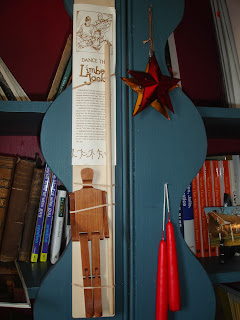
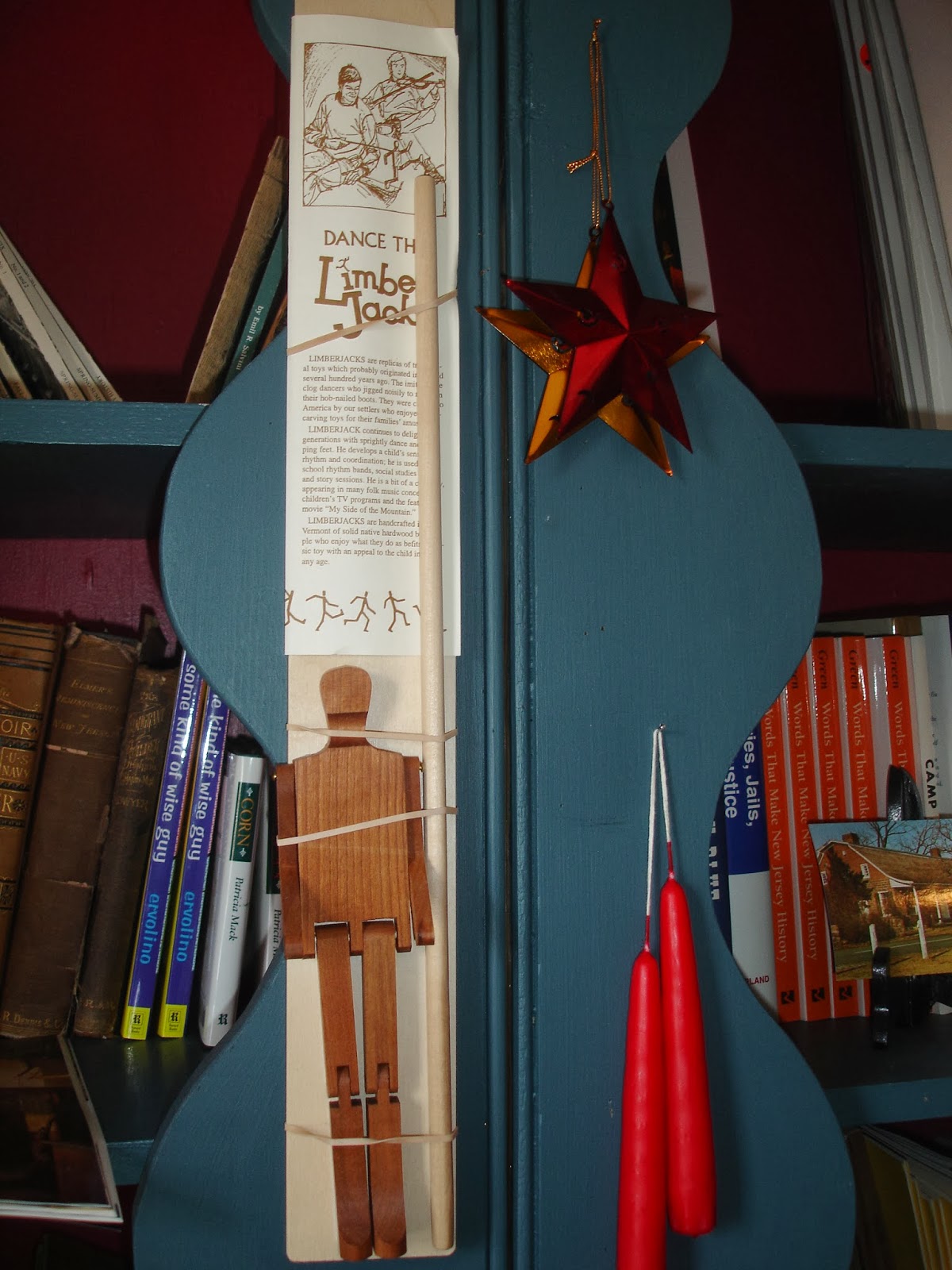
From earlier times, colonial ones, a Limberjack for merriment while music making, and homemade candles.
 The barn beside the Abram Demaree Homestead in Closter, New Jersey.
"Harriet Adams described the special jubilation and excitement she felt as a child in the 1870s, remembered hearing...
'Twas the night before Christmas, and all through the house, not a creature was stirring, not even a mouse.' Then too, the moon and the weather must have fitted in more perfectly to the description, 'The moon on the breast of the new fallen snow, gave the luster of midnight to the objects below."
"In children the sense of comparative values is largely underdeveloped, and I doubt very much if children of the present day, with the profusion of toys now attainable, derive any more joy from their expensive array than we did, with the less expensive and simpler ones which Santa gave us."
As I age, I cherish the winter as a season of fire and light, greenery from the woods that fulfills us while our spring and summer gardens are dormant, and a time of quiet in our harried lives. With the exception of the barn photo above, images shared are from past visits to my favorite local historical group, the Bergen County Historical Society. They are my winter postcards to you, and I send you warmest wishes from my home in New Jersey for a happy Christmas, a rich New Year (remember, that's not in the monetary sense) and a restorative winter season.
Fire in the Dutch Out Kitchen, with water for brewing tea and a corn chowder ready for cooking.


Brussels sprouts ready for roasting.

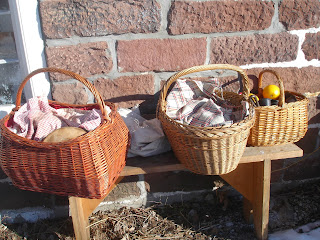
Baskets outside the out kitchen. Steve has rescued so many baskets from the curbside people toss aside. I adore baskets.

Also the pleasure of oranges in winter, like those in the far right. From the chapter, "The Birthday Party" from Laura Ingalls Wilder's Little Town on the Prairie,
"Laura was wondering about the orange before her. If those oranges were meant to be eaten, she did not know when nor how. They were so pretty, it was a pity to spoil them. Still, she had once eaten part of an orange, so she knew how good an orange tastes."
The door to the out kitchen adorned with corn, decorations invoking nature and her bounty are always favorites.

Books to stir the imagination. When I see all these children glued to their screens at restaurants, I often think, whatever happened to coloring? Keep coloring books alive!

Light leading up the doorway, with a welcoming pineapple, apples and greenery over the door.

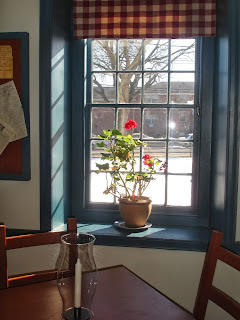
A geranium. For the first time this year, I'm trying to keep my geraniums alive indoors as our pioneer sisters did.

Winter was always a joyful time, complete with sledding in a local park, building snowmen and making snow angels in our backyard, and ice skating and hot cocoa at an ice skating rink. "Experience" versus "things" is what my heart recalls. It's been far too long sine I've made a snowman. Here is one from a park.

Christmastime and winter still are anticipated with a happy and hopeful heart. We have stopped exchanging gifts in our family, mostly put off by the materialism of the holiday. I look forward to our Christmas Eve fondue, my mom's Swiss German Christmas cookies, the glow of the candles that warm our home and such. Winter brings brisk walks with the dogs, who by their excitement remind me, unless it is dangerous, to never hesitate to be in and savor nature whatever mood she is in, and also provides gratitude for our nice, cozy home when the temperatures dip. It is also a time to read (although I enjoy that year-round), watch the birds gather eagerly at the feeder, and let the soul and mind quiet and the body rest. Naps are aplenty.
I spoke in my Philadelphia post that history puts everything into perspective for me. I subscribe to a monthly newsletter from the Laura Ingalls Wilder Memorial Society, which shared this quote for December from her book, "Little House on the Prairie."
"And in the very toe of each stocking was a shining bright, new penny! They had never even thought of such a thing as having a penny. Think of having a whole penny for your very own. Think of having a cup and a cake and a stick of candy and a penny.
There had never been such a Christmas."
How much have times changed since Laura's childhood in the American West in the 1800s. I remembered her simple pleasures when I read the New York Times article, "Babes in Digital Toyland," describing children on Main Street in Midland, Michigan (but could be main street anywhere) whispering in Santa's ear their wishes: "cellphone," "iPad," "Notebook." Children as young as three are getting devices. Am I the only one getting the blues over all these tablets for toddlers?
I linked back to the article, which I found downright depressing if you want to read more. Just because corporations seeking to profit from the masses are marketing something as "progress" does not make it so. Someone complained to me about the high tech toys her young daughter wanted. I suggested Laura's Little House books. Do people give books - real books - as gifts? I hope so.
The airwaves are flooded with advertisements that everyone wants these devices and you'll be the hero of your family if you give them one for the holidays. I wouldn't want an iPad or iPhone if someone gave me one for free. I'm living quiet contentedly "app-free" (and have quite more money using what I have instead of upgrading to things I don't need).
A comment in The New York Times article stuck with me, and it speaks to a world of interaction and going out and living life, not just watching it on a screen.
"I homeschooled my children for several years after my son was bullied at the public school. We staged two Shakespeare plays each year. We went to every museum in New England and New York. We made art every day with various materials. We read and read and read. We did a lot of Lego construction. We did simple math and then moved to geometry and algebra. We did a road trip once a month. We cooked, baked, crafted and constructed some pretty amazing snowmen. We had a lot of beachcombing days. It was the best time of our lives. The only screen was the TV screen, and that was not turned on until the late afternoon. My kids are pretty skilled adults now, but they talk about homeschooling with a kind of nostalgia that I never expected."
For the New Year, let's give ourselves a goal of less screen time too. I'm going to get out in nature and listen for birdsong before checking e-mail in the morning. Less turning on the television mindlessly, more reading. Enjoy two underrated treasures: peace and quiet.
I turn to pioneer writings for reflection and perspective. I don't want to romanticize the pioneer times too much. For instance, I'm grateful for the advances in health care (one only need to walk through an old cemetery to see the large number of children lost so young) and my thought is always in the back of my mind, "What about the Native Americans whose land this was we settled on?"
But there is something universal that transcends centuries that appeals to me. I'm sharing with you some writings from "Pioneer Women: Voices from the Kansas Frontier," Joanna Stratton's collection of these women's memories from all those years ago.
But there is something universal that transcends centuries that appeals to me. I'm sharing with you some writings from "Pioneer Women: Voices from the Kansas Frontier," Joanna Stratton's collection of these women's memories from all those years ago.
"Like children everywhere, pioneer youngsters anxiously awaited the arrival of Santa Claus. In contrast to the austerity and hardships in their lives, they treasured the few simple gifts tucked into their stockings and eagerly joined in the recitations of holidays poems and prayers and the singing of carols. Mary Rarick Rouse wrote: We knew the Christmas story well and the boy Jesus whose birthday it was. As for gifts, if we every had any they were homemade. No toys to buy if we wanted them, and nothing to buy with. Our stocking was always hung up, faith of childhood for Santa, an apple or popcorn ball or wooden doll or rag one, all homemade. We always found something and how happy we were."
From earlier times, colonial ones, a Limberjack for merriment while music making, and homemade candles.
 The barn beside the Abram Demaree Homestead in Closter, New Jersey.
"Harriet Adams described the special jubilation and excitement she felt as a child in the 1870s, remembered hearing...
'Twas the night before Christmas, and all through the house, not a creature was stirring, not even a mouse.' Then too, the moon and the weather must have fitted in more perfectly to the description, 'The moon on the breast of the new fallen snow, gave the luster of midnight to the objects below."
"In children the sense of comparative values is largely underdeveloped, and I doubt very much if children of the present day, with the profusion of toys now attainable, derive any more joy from their expensive array than we did, with the less expensive and simpler ones which Santa gave us."
As I age, I cherish the winter as a season of fire and light, greenery from the woods that fulfills us while our spring and summer gardens are dormant, and a time of quiet in our harried lives. With the exception of the barn photo above, images shared are from past visits to my favorite local historical group, the Bergen County Historical Society. They are my winter postcards to you, and I send you warmest wishes from my home in New Jersey for a happy Christmas, a rich New Year (remember, that's not in the monetary sense) and a restorative winter season.
Fire in the Dutch Out Kitchen, with water for brewing tea and a corn chowder ready for cooking.

Biscuits and tea by a beloved blue and white pitcher.

Brussels sprouts ready for roasting.

Baskets outside the out kitchen. Steve has rescued so many baskets from the curbside people toss aside. I adore baskets.

Also the pleasure of oranges in winter, like those in the far right. From the chapter, "The Birthday Party" from Laura Ingalls Wilder's Little Town on the Prairie,
"Laura was wondering about the orange before her. If those oranges were meant to be eaten, she did not know when nor how. They were so pretty, it was a pity to spoil them. Still, she had once eaten part of an orange, so she knew how good an orange tastes."

The door to the out kitchen adorned with corn, decorations invoking nature and her bounty are always favorites.

Books to stir the imagination. When I see all these children glued to their screens at restaurants, I often think, whatever happened to coloring? Keep coloring books alive!

Light leading up the doorway, with a welcoming pineapple, apples and greenery over the door.

A geranium. For the first time this year, I'm trying to keep my geraniums alive indoors as our pioneer sisters did.

A betty lamp, among the backdrop of an old red barn. Give thanks for the light. Have faith that in times that seem like darkness, the light is there.


