Showing posts with label Laura Ingalls Wilder. Show all posts

Wednesday, December 25, 2013

My Wish I'm Asking Santa to Grant: A More Simple Christmas

Reflect silently or aloud your cherished memories of Christmas as a child, if you celebrate it. I remember not so much the presents, but the anticipation of them, playing board games with my older sister Michele in her bedroom after dinner while Santa Claus arrived. We stuck our heads out the window hoping to catch a glimpse of his sleigh.

Winter was always a joyful time, complete with sledding in a local park, building snowmen and making snow angels in our backyard, and ice skating and hot cocoa at an ice skating rink. "Experience" versus "things" is what my heart recalls. It's been far too long sine I've made a snowman. Here is one from a park.


Christmastime and winter still are anticipated with a happy and hopeful heart. We have stopped exchanging gifts in our family, mostly put off by the materialism of the holiday. I look forward to our Christmas Eve fondue, my mom's Swiss German Christmas cookies, the glow of the candles that warm our home and such. Winter brings brisk walks with the dogs, who by their excitement remind me, unless it is dangerous, to never hesitate to be in and savor nature whatever mood she is in, and also provides gratitude for our nice, cozy home when the temperatures dip. It is also a time to read (although I enjoy that year-round), watch the birds gather eagerly at the feeder, and let the soul and mind quiet and the body rest. Naps are aplenty.

I spoke in my Philadelphia post that history puts everything into perspective for me. I subscribe to a monthly newsletter from the Laura Ingalls Wilder Memorial Society, which shared this quote for December from her book, "Little House on the Prairie."

"And in the very toe of each stocking was a shining bright, new penny! They had never even thought of  such a thing as having a penny. Think of having a whole penny for your very own. Think of having a cup and a cake and a stick of candy and a penny.
        There had never been such a Christmas
."

How much have times changed since Laura's childhood in the American West in the 1800s. I remembered her simple pleasures when I read the New York Times article, "Babes in Digital Toyland," describing children on Main Street in Midland, Michigan (but could be main street anywhere) whispering in Santa's ear their wishes: "cellphone," "iPad," "Notebook." Children as young as three are getting devices. Am I the only one getting the blues over all these tablets for toddlers?

I linked back to the article, which I found downright depressing if you want to read more. Just because corporations seeking to profit from the masses are marketing something as "progress" does not make it so. Someone complained to me about the high tech toys her young daughter wanted. I suggested Laura's Little House books. Do people give books - real books - as gifts? I hope so.

The airwaves are flooded with advertisements that everyone wants these devices and you'll be the hero of your family if you give them one for the holidays. I wouldn't want an iPad or iPhone if someone gave me one for free. I'm living quiet contentedly "app-free" (and have quite more money using what I have instead of upgrading to things I don't need).
 
A comment in The New York Times article stuck with me, and it speaks to a world of interaction and going out and living life, not just watching it on a screen.
 
"I homeschooled my children for several years after my son was bullied at the public school. We staged two Shakespeare plays each year. We went to every museum in New England and New York. We made art every day with various materials. We read and read and read. We did a lot of Lego construction. We did simple math and then moved to geometry and algebra. We did a road trip once a month. We cooked, baked, crafted and constructed some pretty amazing snowmen. We had a lot of beachcombing days. It was the best time of our lives. The only screen was the TV screen, and that was not turned on until the late afternoon. My kids are pretty skilled adults now, but they talk about homeschooling with a kind of nostalgia that I never expected."

For the New Year, let's give ourselves a goal of less screen time too. I'm going to get out in nature and listen for birdsong before checking e-mail in the morning. Less turning on the television mindlessly, more reading. Enjoy two underrated treasures: peace and quiet.
 
I turn to pioneer writings for reflection and perspective. I don't want to romanticize the pioneer times too much. For instance, I'm grateful for the advances in health care (one only need to walk through an old cemetery to see the large number of children lost so young) and my thought is always in the back of my mind, "What about the Native Americans whose land this was we settled on?"

But there is something universal that transcends centuries that appeals to me. I'm sharing with you some writings from "Pioneer Women: Voices from the Kansas Frontier," Joanna Stratton's collection of these women's memories from all those years ago.  

"Like children everywhere, pioneer youngsters anxiously awaited the arrival of Santa Claus. In contrast to the austerity and hardships in their lives, they treasured the few simple gifts tucked into their stockings and eagerly joined in the recitations of holidays poems and prayers and the singing of carols. Mary Rarick Rouse wrote: We knew the Christmas story well and the boy Jesus whose birthday it was. As for gifts, if we every had any they were homemade. No toys to buy if we wanted them, and nothing to buy with. Our stocking was always hung up, faith of childhood for Santa, an apple or popcorn ball or wooden doll or rag one, all homemade. We always found something and how happy we were."

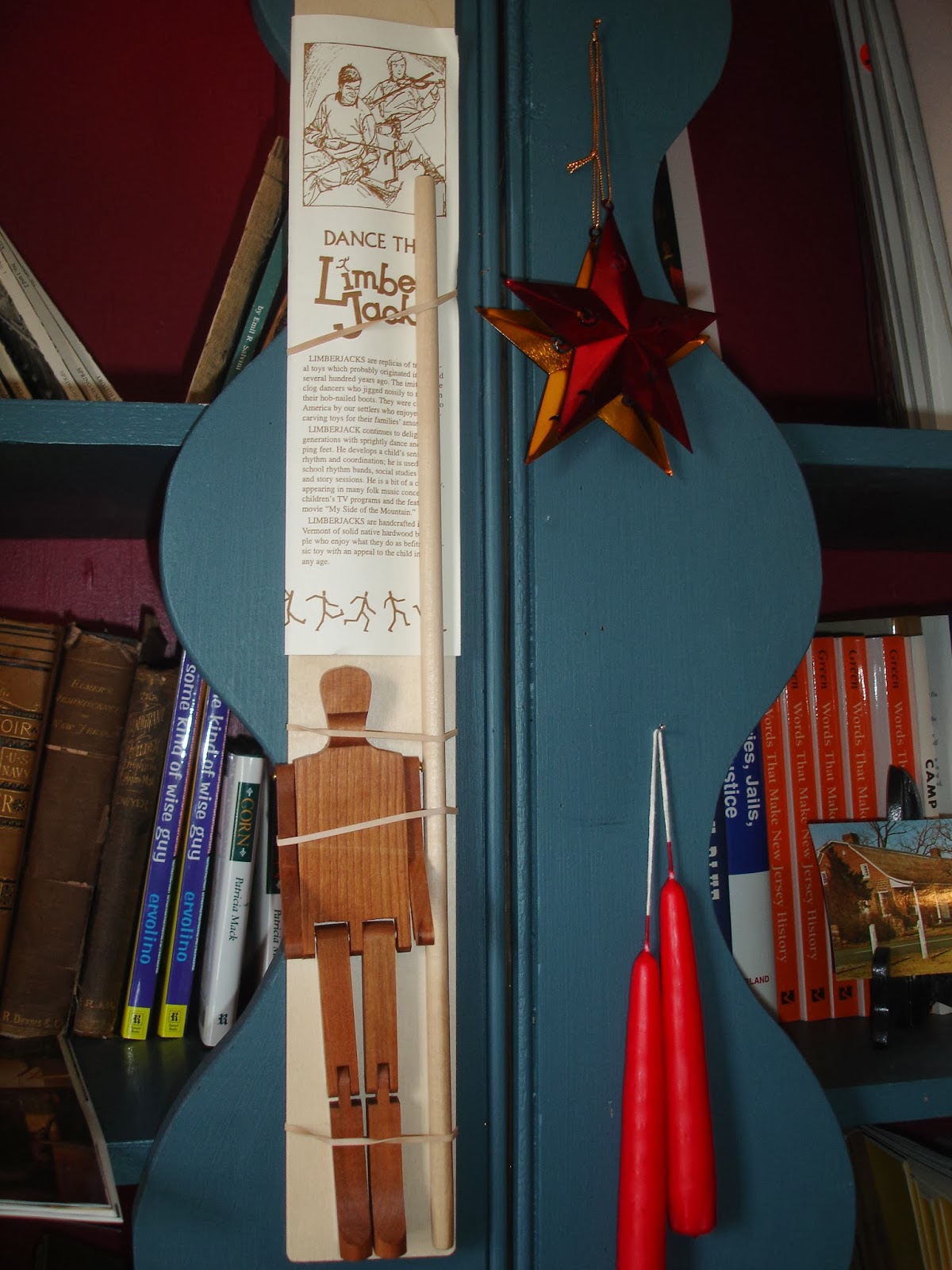
From earlier times, colonial ones, a Limberjack for merriment while music making, and homemade candles.

The barn beside the Abram Demaree Homestead in Closter, New Jersey.

"Harriet Adams described the special jubilation and excitement she felt as a child in the 1870s, remembered hearing...

'Twas the night before Christmas, and all through the house, not a creature was stirring, not even a mouse.' Then too, the moon and the weather must have fitted in more perfectly to the description, 'The moon on the breast of the new fallen snow, gave the luster of midnight to the objects below."

"In children the sense of comparative values is largely underdeveloped, and I doubt very much if children of the present day, with the profusion of toys now attainable, derive any more joy from their expensive array than we did, with the less expensive and simpler ones which Santa gave us."

As I age, I cherish the winter as a season of fire and light, greenery from the woods that fulfills us while our spring and summer gardens are dormant, and a time of quiet in our harried lives. With the exception of the barn photo above, images shared are from past visits to my favorite local historical group, the Bergen County Historical Society. They are my winter postcards to you, and I send you warmest wishes from my home in New Jersey for a happy Christmas, a rich New Year (remember, that's not in the monetary sense) and a restorative winter season.

Fire in the Dutch Out Kitchen, with water for brewing tea and a corn chowder ready for cooking.

 
Biscuits and tea by a beloved blue and white pitcher.


Brussels sprouts ready for roasting.


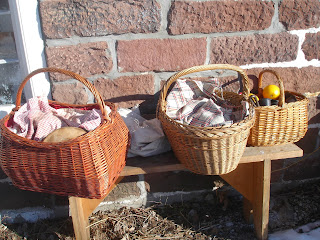
Baskets outside the out kitchen. Steve has rescued so many baskets from the curbside people toss aside. I adore baskets.


Also the pleasure of oranges in winter, like those in the far right. From the chapter, "The Birthday Party" from Laura Ingalls Wilder's Little Town on the Prairie,

"Laura was wondering about the orange before her. If those oranges were meant to be eaten, she did not know when nor how. They were so pretty, it was a pity to spoil them. Still, she had once eaten part of an orange, so she knew how good an orange tastes."

 
The door to the out kitchen adorned with corn, decorations invoking nature and her bounty are always favorites.


Books to stir the imagination. When I see all these children glued to their screens at restaurants, I often think, whatever happened to coloring? Keep coloring books alive!


Light leading up the doorway, with a welcoming pineapple, apples and greenery over the door.


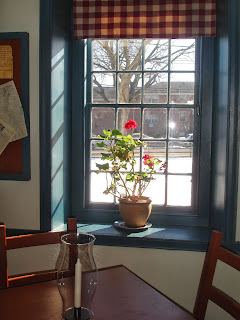
A geranium. For the first time this year, I'm trying to keep my geraniums alive indoors as our pioneer sisters did.
 
A betty lamp, among the backdrop of an old red barn. Give thanks for the light. Have faith that in times that seem like darkness, the light is there.


Friday, November 29, 2013

Reflections on Storytelling: A Visit to the Wilder Homestead

"On a day when she was particularly blue and unhappy, the neighbor to the west, a bachelor living alone, stopped as he was driving by and brought a partly filled grain sack to the house. When Laura opened the door, Mr. Sheldon stepped inside, and taking the sack by the bottom, poured the content out on the floor. It was a paper-backed set of Waverly novels.
 
"Thought they might amuse you," he said. "Don't be in a hurry! Take your time reading them!" And as Laura exclaimed in delight, Mr. Sheldon opened the door, closed it behind him quickly and was gone. And now the four walls of the close, overheated house opened wide, and Laura wandered with brave knights and ladies fair beside the lakes and streams of Scotland or in castles and towers, in noble halls or lady's bower, all through the enchanting pages of Sir Walter Scott's novels.

She forget to feel ill at the sight or smell of food, in her hurry to be done with the cooking and follow her thoughts back into the book. When the books were all read and Laura came back to reality, she found herself feeling much better.

It was a long way from the scenes of Scott's old tales to the little house on the bleak, wintry prairie, but Laura brought back from them some of their magic and music and the rest of the winter passed comfortably." - From the chapter, "A Year of Grace" from Laura Ingalls Wilder's "The First Four Years."

While Laura was trying to escape the isolated prairie with the outlet of a book, I read Laura Ingalls Wilder and other storytellers to escape what feels like suffocating crowds as I rush about New York City's Port Authority bus terminal, the maddening pace as I make my way to and from work, and the congestion of the area I live in. In this season of gratitude, I'm giving thanks to storytellers. I need storytellers in my life for my mental soundness as much as a doctor for my physical well-being. They walk with me in my life, their words become part of my spirit.

Remembering Laura's words as I reflect on my visit in September to the Wilder Homestead in Malone, New York. This is the boyhood home of husband Almanzo Wilder and is the setting for her book, Farmer Boy, based on his childhood spent there.

"In the corner between the window to the east and the window to the south was a small stand-table with an easy armchair at one side and a small rocker at the other. Above it suspended from the ceiling was a glass lamp with glittering pendants. That was the parlor part of the room, and when copies of Scott's and Tennyson's poems were on the stand it would be complete. She would have some geraniums growing in cans on the windows and then it would simply be beautiful." - The First Four Years.

Geraniums outside the boyhood home. I will always have geraniums. Maybe love of flowers gets passed on. My grandmother in Switzerland kept geraniums, as did my mother, and I do too.


I couldn't take pictures in the home, but so admired the Willow ware. Here, Willow ware from the Pioneer Farm Museum in Eatonville, Washington, and also thinking of the red-checked tablecloths Laura referred to. We'll visit here at a later time.


We hear about the loss of the American dinnertime when families ate together, but I think too of the storytime. It was a constant thread in Laura's life and books, whether it was reading favorite novels or poetry, serials in the paper or latest news events. Even in commercials today, Americans are portrayed as sitting on their couches glued to their devices without interaction. Is dinnertime and storytime part of your family and was it part of your childhood?

In the parlor, recalling this scene from "Winter Night" in Farmer Boy,

"Mother knitted and rocked in her high-backed rocking chair. Father carefully scraped a new ax-handle with a bit of broken glass. Royal carved a chain of tiny links from a smooth stick of pine, and Alice sat on her hassock, doing her woolwork embroidery. And they all ate popcorn and apples and drank sweet cider, except Eliza Jane. Eliza Jane read aloud the news in the New York weekly paper.


Almanzo sat on a footstool by the stove, an apple in his hand, a bowl of popcorn by his side, and his mug of cider on the hearth by his feet. He bit the juicy apple, then ate some popcorn, then he took a drink of his cider."

Flash forward to Almanzo and Laura as a young married couple with daughter Rose,

"While Manly ate his evening bowl of popcorn and Rose worked her arithmetic sums by the light of the kerosene lamp, Laura read to them all. During those evenings they read The Leatherstocking Tales, Five Little Peppers and How they Grew, Pride and Prejudice, Ben Hur, The House of Seven Gables and Martin Chuzzlewit." - from William Anderson's Laura Ingalls Wilder: A Biography"

Charles Ingalls made sonic stories with his fiddle. Laura said,

"How it made merry with us when we were glad and sympathized with us when we were sad. It gave us songs of praise when we had been good or successful and acted as confessor when we had been bad. Whatever religion, romance and patriotism I have I owe largely to the violin and Pa playing in the twilight." - Laura Ingalls Wilder: A Biography

Some 127 songs are included in the Little House books, and musicologist Dale Cockrell was the force behind "Pa's Fiddle"  a PBS special that is available on DVD and CD and three other CDs. I love the seed was planted simply by Dale reading the books to his young son at night. This is not just a series for girls. His goal is admirable, trying to "change the music consciousness of the nation with the legacy of the music that has been left behind." He says he has been pushing this rock up the mountain for several years, and I think many of us who hope for richer American culture than what is in the mass media now feel like they are pushing a rock up too. Let's push together.


After her visit to San Francisco in 1915 to visit Rose and attend the world's fair, Laura's love of her country home life was reinforced. My soul is so tired of working life in New York City, and can appreciate her words, "We who live in quiet places," Laura wrote in the Ruralist, "have the opportunity to become acquainted with ourselves, to think our own thoughts and live our own lives. " - Laura Ingalls Wilder: A Biography. I want to live in a quieter place, and seek a less harried life.


Laura's mother, Caroline Ingalls wrote in a composition as a schoolgirl, "Who would wish to leave home and wander forth, in the world, to meet its tempests and its storms? Give me a place at home, with a seat at the fireside, where all is happy and free."

There's a whole home industry that tries to convince people their home isn't modern enough. When I watch the HGTV channel, I think how did we come from a nation of this hardy stock who made everything to complaining about walking all the way to their basement to do laundry (imagine), not having a double sink vanity or granite countertops? Oh the suffering. I even saw a commercial suggesting one updates their kitchen for the holidays! Steve and I have been in every house imaginable during our estate sale visits and I've concluded home is about the people in them, not the finishings. Besides, there is always a certainty about anything "modern." Given enough time it will be outdated.

All I want is a place that's snug and cozy.

 
The New York Public Library issued a list of the 100 Great Children's Books of the past 100 years, and I couldn't believe that none of the Little House books made the list. She has so much wisdom to share. Her words to schoolchildren in 1947 are as relevant as ever,
 
"The Little House books are stories of long ago. The way we live and your schools are much different now, so many changes have made living and learning easier. But the real things haven't changed. It is still best to be honest and truthful; to make the most of what we have; to be happy with simple pleasures and to be cheerful and have courage when things go wrong." - From Laura Ingalls Wilder: A Biography.


Those timeless simple pleasures are recalled in Laura's stories. Pioneer families delighted in blueberry season just as I look forward to New Jersey blueberries each summer.
 
"Before dawn next day they were all riding away in the lumber-wagon, wearing their oldest clothes and taking pails and bushel baskets and a big picnic lunch. They drove far into the mountains near Lake Chateaugay, where the wild huckleberries grew.
 
The woods were full of other wagons, and other families berrying. They laughed and sang, and all among the tress you could hear their talking. Every year they all met friends here, that they didn't see any other time. But all of them were busily picking berries; they talked while they worked." - from the chapter, "Summer-time" - Farmer Boy.

 
Laura: "What's that sweet smell, Pa?"
Charles: "It's the smell of the prairie, mixed with the smell of cut wood."
Laura: I'll never forget this smell as long as I live." - Little House on the Prairie - the television miniseries.
 
So much of the Little House books and films to me are about nudging the memory. Of scents, sounds, places and faces. We live in such materialistic times so focused on excess and the next new shiny toy, we get away from what's most essential. Leaving you with Laura's memories of childhood, none of which involves any "thing".
 
"The early memories of home were images that Laura always loved to recall. Later in life she began calling them "the pictures that hang in my memory." The snug, cozy feeling of warm evenings, the voices of Ma and Pa and the soft firelight on the log walls made pictures that never faded for her."
 
"The first remembrance is of my Father always," she wrote. "My first memory is of his eyes, so clear and sharp and blue. Those eyes could look so unerringly along a rifle barrel in the face of a bear or a pack of wolves and yet were so tender as they rested on his Caroline, my mother, or me when I was sick....His arms were so strong...and they carried me many a night when I was sick and restless. I can hear his measured steps yet, back and forth across the floor, feel the comfort of those strong arms and hear his soothing, 'There, there.' And also his kind voice saying, 'Now Caroline, you lie down and sleep'." Of Ma she writes, "lessons learned at Mother's knee last all through life. But dearer than Mother's teachings are little personal memories: Mother's face, Mother's touch, Mother's voice." Laura Ingalls Wilder: A Biography.
 
The Sweet By and By, the song Charles Ingalls requested be played at his funeral.


Sunday, November 17, 2013

Western Time Diary: Yosemite National Park

When the government shutdown was in the news, I couldn't help but feel for all the little businesses that depend on travelers visiting the national parks. We like to patronize these smaller establishments as often as possible when we vacation. For our Yosemite trip, we stayed at the charming Meadow Creek Ranch Bed and Breakfast Inn in Mariposa.

The adorable chicken coop. I felt like I was in a little Irish cottage.


A clawfoot tub invites a soak. There was brandy, tea, fresh coffee and dark chocolates in the room.


Two of my favorite words to describe a home (or in this case, a home away from home), invoked so often by Laura Ingalls Wilder, are "snug" and "cozy" (or cosy).


All the little details make a place homey to me.


A cozy and snug home for fine feathered friends to seek shelter from the elements.


Homemade blueberry and black walnut pancakes (black walnuts grow on the property), with fresh fruit (including figs, which we found so much more abundant in California), orange juice and vanilla chai tea.


The Meadow Creek Ranch served Mariposa Coffee, and we stopped by to take a pound home.


When driving to the bed and breakfast at night, we  pulled the car over and turned off the lights to take in the stars. Recalling when Laura and Charles, her Pa, on the premiere of Little House on the Prairie viewed the majestic starry filled night sky,

Charles, "Hear that?"

Laura, "Hear what, Pa?"

Charles, "Stars. They're singing Hallelujah."

It's hard not to want to sing Hallelujah when seeing Yosemite.


Even in the busiest national parks, one can find moments of solitude. Hiking up to Sentinel Dome, we were the last two left to enjoy the views.
 
 
Ansel Adams capturing Yosemite's beauty so memorably.
 
 
Annie, at age 14, wrote here, "Yosemite is a place of timeless beauty that will never be affected by the greed and woes of humans. Here we can rediscover ourselves, others, and the bonds that connect us with everything. Here is where we realize the incomparable essence of nature."
 
 
 The author Willa Cather so missed the abundant trees of lush Virginia when she moved as a child to the Nebraska plains. Trees were so rare in the plains, she wrote, people would feel anxious about them, and visit them as if they were people.


We should treat them with sacred awe, for they are a life force.


I feel anxious we are not concerned enough about protecting our lands. For instance, there are so many ads on television from gas companies trying to convince Americans how good natural gas is. I said to my husband, if natural gas is so wonderful, why are these corporations spending so much time and money to convince people in feel-good commercials? Whenever I see warm and fuzzy advertisements from oil companies, I immediately question.


The film Promised Land portrays how natural gas companies get landowners to sign over their land to extract natural gas through fracking. Frances McDormand plays Sue and Matt Damon is Steve, who are trying to do just that. Sue tells an anxious mother about the better school her daughter can go to. "Everything to me starts with an education." An education is correct, but who is doing the educating? Those that seek to benefit?

When Sue and Matt arrive, a store clerk is so happy to see them. He says, "We can't sell the scenery, can we?"

I think we can (the parks experience is about scenery, but then the greater lesson is of stewardship), and it's time to introduce a word that has gone missing: conservation. Steve says, "Unless we talk about cutting consumption and so far that's a conversation none of want to have." We simply must conserve as much as we can. The land cannot give more. In J.J. Brown's  Brindle 24, a cautionary novel about fracking, it was wisely stated, "We had paradise. We threw it away." Let us not throw our paradise away.

The naming of Yosemite has a dark story with roots in the gold rush, according to Ken Burns' The National Parks: America's Best Idea. In 1851, a group of white men calling themselves the Mariposa Battalion were armed and looking for Indians to drive out of their homelands from the western Sierra Nevadas. Lafayette Bunnell, so awed by the landscape here, thought they name the place they came upon, and suggested Yosemite, which he thought was the name of the tribe they were displacing. In fact, Yosemite refers to people who should be feared. It means, "They should be killers." Watch the clip here.


"We signed a paper that said they could take the trees, signed a paper that said they could take the copper from the earth," said the old chief Bizhiki, disturbed, "We didn't say they could take the earth.

Who can take the earth?" - The Game of Silence by Louise Erdrich.

Erdrich penned a series of books, beginning with the Birchbark House, about a tribe whose main focus is Omakayas, a young girl living not long before Laura Ingalls Wilder. If you read the Little House books, they are a wonderful comparison, especially for children, as these are tribes the pioneers would displace. Disney adapted a film version of Little House on the Prairie, and there's a moving scene when Charles Ingalls passes the Osages. Their chief tells him,

"This land knows our stories. The wind knows the names of the children before they're born. But this should all be yours. Why do you think so? Do our memories matter less? Does our laughter not lift its way to heaven as yours does?"


In an interview, the mother of Tori Amos, who has Eastern Cherokee roots, was asked if she felt different growing up because of her background. She recalled not knowing a difference until she went to college and observed of her classmates, "They didn't have the same respect I suppose or love for the nature I was taught and for the animals and spirits."

Tori Amos recalls,

"As I was researching for this record [Scarlet’s Walk], a Native American woman came back to see me on the last tour and she said to me, “The people that hold the land and the white brother that owns the land must come together for the sake of her survival.

And I said to her,

"But so much has been taken from you and your people already."
 
There were tears rolling down her face, and she said “Sadly enough my dear the white brother only took the land. Now he needs to take more.”
 
This woman, older, no fanfare, but her commitment to building bridges to a people that has not integrated her stories, her people’s culture. She still is compassionate and holds a space by the fire. When you stop holding a space by the fire, then there’s no chance for the people that own the land to know what they really don't have access to. It isn't taught in our schools. Their culture is segregated. They are marginalized. Yet, they are still willing to share, even though they've lost so much. Yet still not pretend that agreements weren’t broken, that there wasn’t betrayal.

So I learned a lot in this woman's activism that she carried a torch and she carried a tomahawk but she carried compassion in her other hand."


I wish we had a modern day John Muir to advocate for the land. We need a space at the fire to talk about these issues. I hope to see you there.


Sunday, October 20, 2013

Western Time Diary: San Francisco

It has taken me until now to post my California diary here, Western Time, in a nod to Laura Ingalls Wilder's remark to her husband Almanzo when the time zone changes, "Western time now" in the collection of letters "West from Home." The West does feel so different from fast-paced life commuting to New York City from congested northern New Jersey.

In the R.E.M. song, I Remember California, Michael Stipe sings of memories of redwood trees, bumper cars and wolverines, the ocean's trident submarines, lemons, limes and tangerines. Here is what I remember of San Francisco, where Steve and I spent the first leg and last of our honeymoon in early October last year which I still want to document as love letters to a very happy time, including some reflections on my American dream.

The Golden Gate Bridge, of course! History-loving me wanted to know the origin of "golden gate," and according to the bridge's web site,

"The Golden Gate Strait is the entrance to the San Francisco Bay from the Pacific Ocean...It is generally accepted that the strait was named "Chrysopylae", or Golden Gate, by John C. Fremont, Captain, topographical Engineers of the U.S. Army circa 1846. It reminded him of a harbor in Istanbul named Chrysoceras or Golden Horn."

Of course, gold would play a huge role in the development of the state, and we'll visit a gold rush town a little later.


The art deco architecture of Ocean Park Motel, which opened in 1937, the same year as the Golden Gate bridge. The rooms were on the small side but this was just fine. I needed a comfortable bed at the end of the day to rest my head, and I love the retro feel here. I kept having my favorite old Hollywood movie star Dick Powell's music running through my head. Mr. and Mrs. is the Name felt appropriate.


Loved their zen hot tub area.

 
In a word, I'd have to describe the whole vibe of San Francisco on this trip as "zen."


Breakfasts like granola bowls  with fresh fruit, cinnamon sugar baguettes, and hummus bagels with sprouts and soy lattes at the nearby Java Beach Cafe. The presidential debates were being held while we were here, and the locals gathered over their newspapers and had lively discussions. It's hard to believe we are already talking about the next presidential election. I like to "vote" with how I spend my dollars, including patronizing small businesses as often as possible. Politicians can talk about helping small business, but it's up to the masses to support them. That's my contribution to this morning's cafĂ© political round table.


Strolling on the beach after breakfast. These waters are too rocky for swimming, though I meant to wade like Laura did in the Pacific Ocean. Leave it to Laura to wade!


Haight Ashbury. I found a nature-inspired green dress at a vintage shop on the corner here that reminds me of the woods. One of the things I love to vote and advocate for is a strong reuse market.

We didn't register for our wedding, and asked for honeymoon contributions instead, so our entire trip was paid for. We've outfitted our household since we moved into our two family home almost entirely through secondhand (garage and estate sales, charity thrift shops and even curbside rescues).  As often as I can (I'm not perfect), I vote again corporations with their cheap foreign made wares they sell to the public, and that's my hippie spirit of the 60s.


 I love seeking out gardens in big cities. One of my favorite places in New York? The New York Botanical Garden in the Bronx. Strolling the peaceful Japanese tea garden in Golden Gate Park here.


Lunch at the tea house.

Jasmine tea, miso soup and fortune cookies. Some history on fortune cookies from the tea garden's site:

"According to family members, Mr. Hagiwara introduced fortune cookies to the United States from Japan in the 1890's or early 1900's. Initially, the cookies were made on site by hand using a special iron mold or kata. When demand grew, Mr. Hagiwara hired San Francisco confectioner Benkyodo to produce the fortune cookies in large quantities.  Original fortune cookies made in Japan were savory rather than sweet, and it is believed that Benkyodo developed a vanilla recipe for Mr. Hagiwara to make it more appealing to Western palates, the flavor that is now widely popular across the U.S."


 Green tea with kuzuomochi, sweet rice cakes in flavors of green tea, mango and strawberry.

 
We also toured the botanical gardens. I think blue flowers are my most favorite. Author Elizabeth Gilbert recalled her "gardening mother's wise adage, which she used to tell us all the time when we were kids: Every day that goes by that you do not touch the soil, you aren't really alive." I feel more alive when I observe the magnificence of nature each day.
 

The Fog City Diner. More art deco love.


Not your average diner food. At the Fog City Diner, butter lettuce, walnuts, grilled pears, goat cheese in a citrus vinaigrette.

The seals by the wharf. I don't know how they get any sleep!


A salted caramel hot chocolate on a brisk, windy day at Ghirardelli Square.


The tomato soup bread bowl at Boudin Bakery. The Fisherman's Wharf area is very touristy, yes, but sometimes it's okay to do the "touristy" things, because well, you are!


A tea tasting at Vital Tea Leaf in Chinatown. I sampled wonderful teas, including a rose tea, and left with a batch of rosemary lavender green tea. I feel like I'm drinking in the garden physically and spiritually when I have it. A friend of mine referred to the "ritual" of her tea routine and I love that word to describe savoring a cup of tea.


Steamed veggie dumplings at a restaurant in Chinatown.


The Palace of the Fine Arts, from the Pan-Pacific International Exposition which Laura was visiting in 1915 which she wrote about in West from Home. We came here around dinnertime and practically had the place to ourselves. I'm so glad Laura led me here. I believe in surrounding yourself by people who make your life more fulfilling, and that includes storytellers.


Driving down the crooked Lombardi Street at dusk.


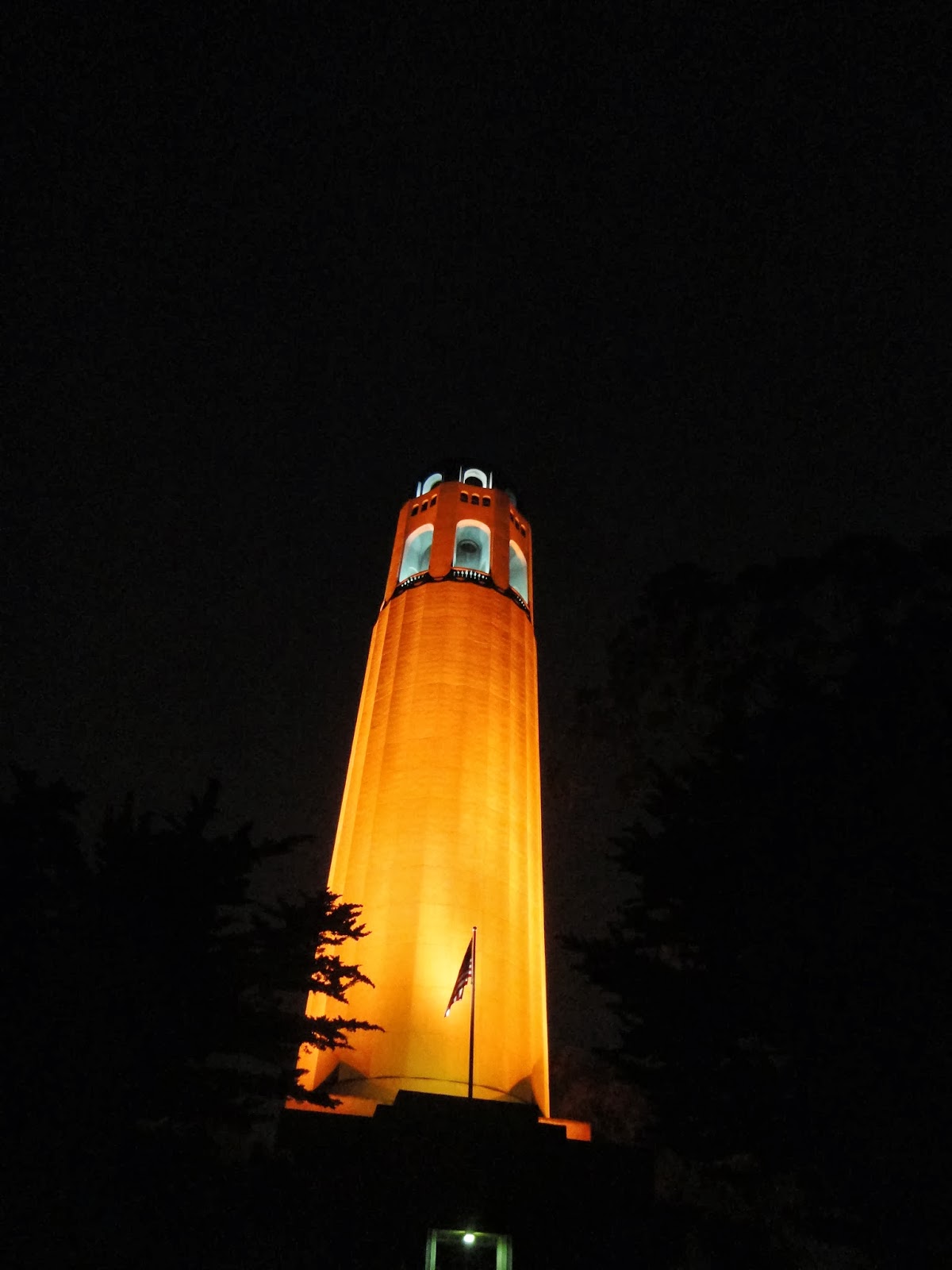
Coit Tower by night.


The view from the Coit tower.


The eco-friendliness of the city. Curbside composting bins? Why doesn't every city have that? We were here on the first day of the plastic bag ban and 10 cent fee for bags, something I favor after having done numerous river cleanups and seeing where these end up.


The City Lights Bookstore. With the popularity of so many electronic readers, I worry for these book shops. I find so much of what I read because someone bought a print book and passed it on to a thrift shop or library book sale. I'm sticking to my print books - threat of dirty electricity, zero.


Alcatraz. Some unexpected things I learned here:

That long before Occupy Wall Street, there was an actual occupation of Alcatraz Island in 1969, taking a "stand again broken treaties, broken treaties, and broken lives suffered by America's native people since the arrival of European explorers in the fifteenth century."

The treatment of the Native Americans is one of the darkest spots on our nation's history, and remains shameful. We'll visit this more when we get to Yosemite.


Amid a world of criminals, movements towards civility, such as the impressive libraries, and...

the prisoner gardens.


A spot of refreshment for birds of flight, amid the former home of so many caged birds.


Lunch in Sausalito, which reminded me of being in Italy. My avocado and brie cheese club with a California white zinfandel at Venice Gourmet.


Two more places coming up for reflections on nature before we get to the wine country.