Sunday, October 20, 2013

Western Time Diary: San Francisco

It has taken me until now to post my California diary here, Western Time, in a nod to Laura Ingalls Wilder's remark to her husband Almanzo when the time zone changes, "Western time now" in the collection of letters "West from Home." The West does feel so different from fast-paced life commuting to New York City from congested northern New Jersey.

In the R.E.M. song, I Remember California, Michael Stipe sings of memories of redwood trees, bumper cars and wolverines, the ocean's trident submarines, lemons, limes and tangerines. Here is what I remember of San Francisco, where Steve and I spent the first leg and last of our honeymoon in early October last year which I still want to document as love letters to a very happy time, including some reflections on my American dream.

The Golden Gate Bridge, of course! History-loving me wanted to know the origin of "golden gate," and according to the bridge's web site,

"The Golden Gate Strait is the entrance to the San Francisco Bay from the Pacific Ocean...It is generally accepted that the strait was named "Chrysopylae", or Golden Gate, by John C. Fremont, Captain, topographical Engineers of the U.S. Army circa 1846. It reminded him of a harbor in Istanbul named Chrysoceras or Golden Horn."

Of course, gold would play a huge role in the development of the state, and we'll visit a gold rush town a little later.


The art deco architecture of Ocean Park Motel, which opened in 1937, the same year as the Golden Gate bridge. The rooms were on the small side but this was just fine. I needed a comfortable bed at the end of the day to rest my head, and I love the retro feel here. I kept having my favorite old Hollywood movie star Dick Powell's music running through my head. Mr. and Mrs. is the Name felt appropriate.


Loved their zen hot tub area.

 
In a word, I'd have to describe the whole vibe of San Francisco on this trip as "zen."


Breakfasts like granola bowls  with fresh fruit, cinnamon sugar baguettes, and hummus bagels with sprouts and soy lattes at the nearby Java Beach Cafe. The presidential debates were being held while we were here, and the locals gathered over their newspapers and had lively discussions. It's hard to believe we are already talking about the next presidential election. I like to "vote" with how I spend my dollars, including patronizing small businesses as often as possible. Politicians can talk about helping small business, but it's up to the masses to support them. That's my contribution to this morning's café political round table.


Strolling on the beach after breakfast. These waters are too rocky for swimming, though I meant to wade like Laura did in the Pacific Ocean. Leave it to Laura to wade!


Haight Ashbury. I found a nature-inspired green dress at a vintage shop on the corner here that reminds me of the woods. One of the things I love to vote and advocate for is a strong reuse market.

We didn't register for our wedding, and asked for honeymoon contributions instead, so our entire trip was paid for. We've outfitted our household since we moved into our two family home almost entirely through secondhand (garage and estate sales, charity thrift shops and even curbside rescues).  As often as I can (I'm not perfect), I vote again corporations with their cheap foreign made wares they sell to the public, and that's my hippie spirit of the 60s.


 I love seeking out gardens in big cities. One of my favorite places in New York? The New York Botanical Garden in the Bronx. Strolling the peaceful Japanese tea garden in Golden Gate Park here.
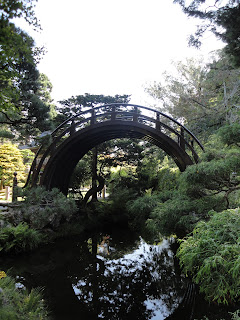


Lunch at the tea house.

Jasmine tea, miso soup and fortune cookies. Some history on fortune cookies from the tea garden's site:

"According to family members, Mr. Hagiwara introduced fortune cookies to the United States from Japan in the 1890's or early 1900's. Initially, the cookies were made on site by hand using a special iron mold or kata. When demand grew, Mr. Hagiwara hired San Francisco confectioner Benkyodo to produce the fortune cookies in large quantities.  Original fortune cookies made in Japan were savory rather than sweet, and it is believed that Benkyodo developed a vanilla recipe for Mr. Hagiwara to make it more appealing to Western palates, the flavor that is now widely popular across the U.S."


 Green tea with kuzuomochi, sweet rice cakes in flavors of green tea, mango and strawberry.

 
We also toured the botanical gardens. I think blue flowers are my most favorite. Author Elizabeth Gilbert recalled her "gardening mother's wise adage, which she used to tell us all the time when we were kids: Every day that goes by that you do not touch the soil, you aren't really alive." I feel more alive when I observe the magnificence of nature each day.
 

The Fog City Diner. More art deco love.


Not your average diner food. At the Fog City Diner, butter lettuce, walnuts, grilled pears, goat cheese in a citrus vinaigrette.

The seals by the wharf. I don't know how they get any sleep!


A salted caramel hot chocolate on a brisk, windy day at Ghirardelli Square.


The tomato soup bread bowl at Boudin Bakery. The Fisherman's Wharf area is very touristy, yes, but sometimes it's okay to do the "touristy" things, because well, you are!


A tea tasting at Vital Tea Leaf in Chinatown. I sampled wonderful teas, including a rose tea, and left with a batch of rosemary lavender green tea. I feel like I'm drinking in the garden physically and spiritually when I have it. A friend of mine referred to the "ritual" of her tea routine and I love that word to describe savoring a cup of tea.


Steamed veggie dumplings at a restaurant in Chinatown.


The Palace of the Fine Arts, from the Pan-Pacific International Exposition which Laura was visiting in 1915 which she wrote about in West from Home. We came here around dinnertime and practically had the place to ourselves. I'm so glad Laura led me here. I believe in surrounding yourself by people who make your life more fulfilling, and that includes storytellers.


Driving down the crooked Lombardi Street at dusk.


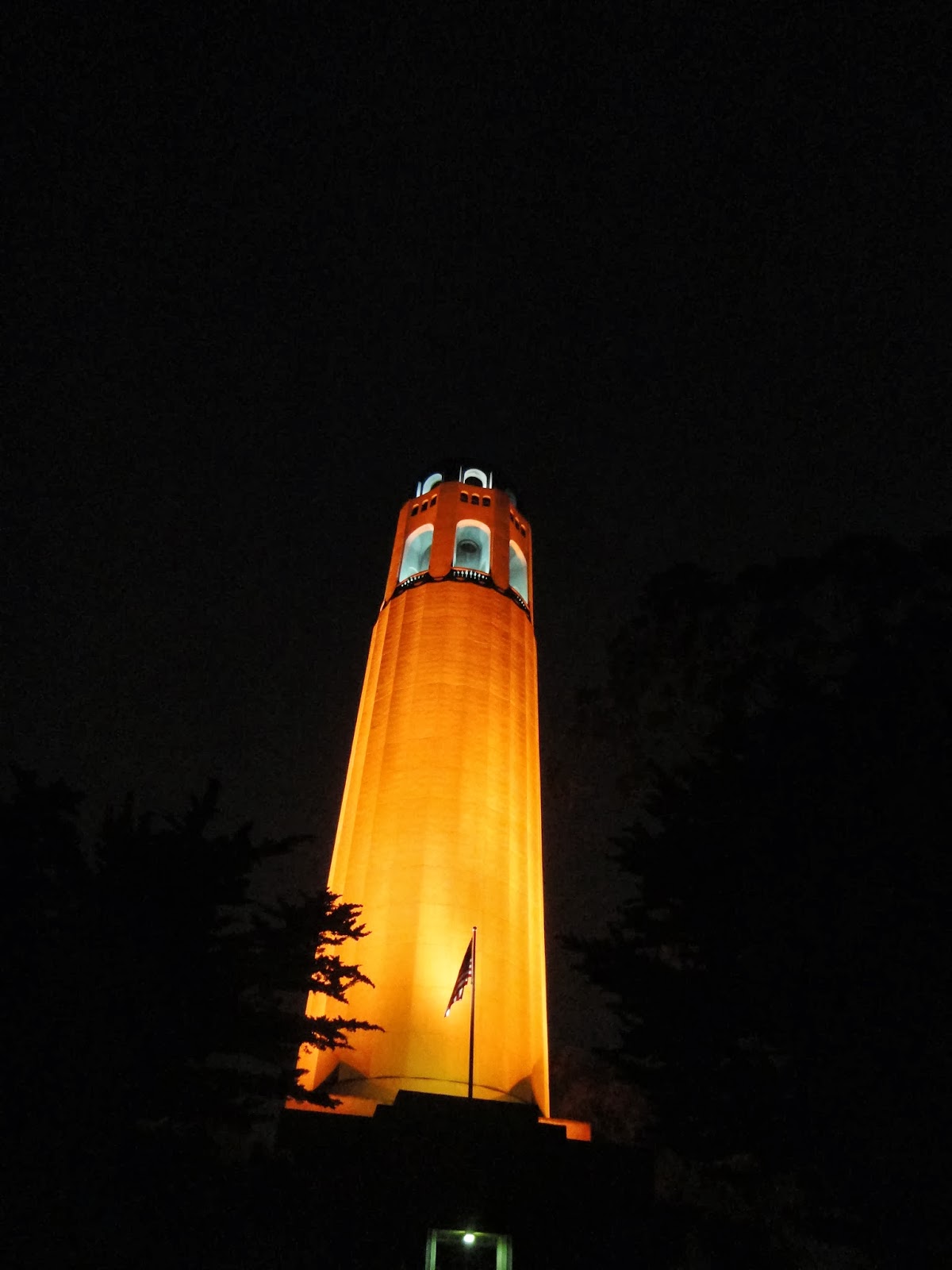
Coit Tower by night.


The view from the Coit tower.


The eco-friendliness of the city. Curbside composting bins? Why doesn't every city have that? We were here on the first day of the plastic bag ban and 10 cent fee for bags, something I favor after having done numerous river cleanups and seeing where these end up.

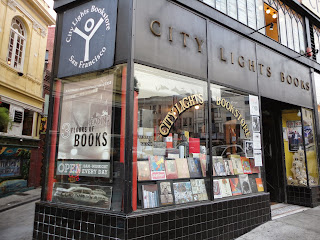
 

The City Lights Bookstore. With the popularity of so many electronic readers, I worry for these book shops. I find so much of what I read because someone bought a print book and passed it on to a thrift shop or library book sale. I'm sticking to my print books - threat of dirty electricity, zero.


Alcatraz. Some unexpected things I learned here:

That long before Occupy Wall Street, there was an actual occupation of Alcatraz Island in 1969, taking a "stand again broken treaties, broken treaties, and broken lives suffered by America's native people since the arrival of European explorers in the fifteenth century."

The treatment of the Native Americans is one of the darkest spots on our nation's history, and remains shameful. We'll visit this more when we get to Yosemite.


Amid a world of criminals, movements towards civility, such as the impressive libraries, and...

the prisoner gardens.


A spot of refreshment for birds of flight, amid the former home of so many caged birds.


Lunch in Sausalito, which reminded me of being in Italy. My avocado and brie cheese club with a California white zinfandel at Venice Gourmet.


Two more places coming up for reflections on nature before we get to the wine country.


Sunday, October 13, 2013

A Letter on Puppies and Life Unplugged

Dear readers,

My mother asked me if I still have my blog. In short, yes, but my blog has been a diary I haven't felt like writing in. I think of the pioneer diaries (both real and fictitious) I love reading where they write frequently but then months go by and there's no mention. I notice a lot of my favorite blogs I follow are posting much less frequently. I suspect, like me, realities of everyday life have taken over.

Life does certainly lead us on unexpected paths, good and bad. Our path is covered with paw prints, which explains in part my radio silence here. Let me introduce you to our family dog, Nikki (we kept the name she came with).


About one month after our return from our honeymoon trip to northern California, my husband Steve brought this sweet girl into our lives, whom he personally rescued from a family who needed to "get rid of her" (their words) as soon as possible and who was being left outdoors on a cold back porch.

My mother took one look at her and said, "That dog's pregnant!" A visit to the vet shortly after confirmed it, and that same night, eight lives entered this world, two on our bedroom floor, six in the adjoining bathroom. Steve can now add "doggy midwife" to his resume.


So we were consumed for months, spending time with Owen (named after the title character in John Irving's A Prayer for Owen Meany, who was small in stature but large in spirit), Angelina (Steve thought this pup was the Brad Pitt of the group, but he was a she, so...); Fred and Ethel Mae (of I Love Lucy, although Steve insists Ethel Mae was "Crazy Toe" with her white paws), Hans (our Swiss cow pup, and a nod to my Swiss heritage), Jet (our midnight black pup), Floppy (with these adorable Floppy ears), and Teddy. With the help of a local rescue group, Steve and I spent weekends meeting with families, their doggies, and dropping them off.


No time to make anything out of Mastering the Art of French Cooking. We had an army to feed!


Bath time!


Then there those wonderful lazy days of winter, curled up indoors, nesting. Napping while Steve and I caught up on Dexter. I'm now procrastinating writing new blog entries while I watch Downton Abbey.


Owen was destined to become Augie, Angelina is Callie, Fred is Bode (after Bode Miller), Ethel Mae, now Harley Jane, Hans answers to Momo (a Japanese anime character), Floppy soars as Raven, Teddy is now Miley and Jet is....

Jet, our forever puppy. Here she is pre-groomer. Steve picked her name and it just seems to fit her. Plus I love the Peter, Paul and Mary cover of Leaving on a Jet Plane, which I'll sing to her very off-key.


It was so hard to say goodbye. The tears flowed freely.

There is an episode of the Golden Girls where Dorothy decides to write a letter to her father who passed away to get down all the thoughts she didn't get to say when he was alive. In the end, she decides to write it to her mother instead. She simply writes,

"Thanks for giving me life, and thanks for making it good."

I said this on behalf of the pups to Nikki each time one left. Life certainly is so good.

"As a woman once said to me, one has a great deal of pleasure out of dogs because one can spoil them as one cannot spoil one's children. If the children are spoiled, one's future is spoilt but dogs one can spoil without any thought of the future and that is pleasure." - Gertrude Stein, as quoted in Le Chien de Paris.

After we dropped off our last puppy, we toasted with a bottle of homemade red wine that Teddy's family gave us, and made a fire on our outdoor patio. We've spent many a spring and summer night in front of the fires, just enjoying life offline.


The adventure continued. After the spay surgeries, Nikki and Jet had to bravely wear their cones for 10 days. Our little astronauts...


They were so happy when we came home from our vacation in Washington state in June. I tell them I must have done something really good in my last life to deserve them. One is lucky is to have one best friend in this world. I have two!


I do hope to get back to writing. I've been an absentee commenter on my favorite blogs, a terrible excuse for a pen pal and a blogger gone missing, but I hope to change those things.

I hope you are well, and have a wonderful storyteller on your nightstand. Mine is Elizabeth Gilbert's The Signature of All Things, about a young female botanist in Philadelphia in the 1800s. Gilbert describes the character as a seeker, something we should all strive to be.

Wishing you all the joys of the autumn season, and I'll be in touch soon.

Warmly,
Catherine

Wednesday, January 9, 2013

December Storytellers: A Month of Books

Where have I been? On the prairie in the 1800s. Spending time with a watchmaker mouse. Lost in poetry. In upstate New York searching for clean water and air. These storytellers were my last of 2012, guiding me in my path finding my own American dream, reminding me of what I love: history, the beauty of the word, caretaking for the environment, home, and gratitude.

The Long Winter, Laura Ingalls Wilder, 50 cents, Housing Works Thrift Shop, New York City.

"Historians have written about that hard winter of 1881. It was worse than anybody remembered. I wrote about it too though not so much as a recorder of history as an observer of people and the people I knew on the prairie in those years would have given you a puzzled look if you called them heroes. They ventured into the unknown lands because that is where their hearts took them." - from Beyond the Prairie: The True Story of Laura Ingalls Wilder.

Laura says in Beyond the Prairie, "This is where I told myself I must remember. The feel of things, the scratch of wool on your skin, the sharp smell of a wood fire, the long stagnant afternoons when it seems nothing interest can ever happen."

Laura writes about the heavy undergarment her mother made her wear when she longed for cooler cotton, a blessed event when an unexpected blizzard comes, one of many that would plague De Smet, South Dakota. An old Indian comes in and warns the townspeople of seven months of blizzards, a true prophecy. Pa observes the animals making thicker, more supportive shelters. How often we can take our queues from the animal world.
"Few of us I think have an unmistakable moment to mark the end of childhood. There's just a change, subtle and bewildering, a time when we are suddenly strangers to ourselves until one day we discover the person we have become," Laura says in Beyond the Prairie. She finds herself blossoming from that childhood in her marvelous Little Town on the Prairie,  Laura Ingalls Wilder, 50 cents, Housing Works Thrift Shop, New York City. How I wished to spend a Friday evening at one of the literaries she described. I also remember the simple delights she mentions, like a rare orange at a birthday party for a classmate.

If I could invite five people, living or dead, to a dinner party, Laura Ingalls Wilder would make my list. Laura, how did you feel going from a girl on the prairie entertained by your pa's fiddle to seeing the expansion of the American West, two world wars, the Great Depression, the birth of the aviation industry, and the age of television? I so often feel overwhelmed by the fast moving change in our society, especially with technology. I feel lost in conversations about apps and excitement over devices. Did Laura ever feel overwhelmed by change?


Leave Your Sleep, by Natalie Merchant and Barbara McClintock, free, the library. A beautifully illustrated book for children young and those just young-at-heart, this is an adaption of Merchant's tour-de-force Leave Your Sleep double album she created a few years ago, making songs out of 18th and 19th American and British poems. I've been a long-time fan of Natalie Merchant's works and consider her to be a sonic poet anyway.

Merchant talks about being a latecomer to poetry. I too feel like I've arrived late for the party, but I'm glad Ms. Merchant has helped open the door. "A poet transports you to a place where you can experience what they saw, what they felt, what they smelled, what they touched."

And thankfully, someone talking about aging gracefully.

Merchant writes in the introduction,

"This collection of songs represents the long conversation I had with my daughter during the first six years of her life. It documents our word-of-mouth tradition in the poems, stories, and the songs that I found to delight and teach her...I tried to show her that her speech could be the most delightful toy in her possession and that her mother tongue is rich with musical rhythms and rhymes. With these poems, I gave her parables with lessons on human nature and bits of nonsense to challenge the natural order of things and to sharpen her wit. Poetry speaks of so much: longing and sadness, joy and beauty, hope and disillusionment. These are the things that make a childhood, that time when we wake up to the great wonders and small terrors of our world. Poets are our soft-spoken clairvoyants. But poetry on the page can be difficult to penetrate; sometimes it needs to be heard."


Time to Smell the Roses by Michael Hoeye, $3.98, Better World Books. Watchmaker mouse Hermux Tantamoq is back with another wonderful adventure, this time in the battle over fragrance.  Rose is one of my favorite fragrances, and after reading this book I have new meaning when I spray on my thrifted bottle of Tea Rose perfume from the Perfumer's Workshop. I thought of this book when reading a New York Times article on celebrity fragrances and made me wonder why everyone needs to be an industry now.
Returning here too is the deliciously wonderful love-to-hate Tucka Mertslin, the neighbor of Hermux and the cosmetics tycoon who would never age gracefully. Think Nellie Oleson in mouse form. I love the underlying commentary here about the beauty industry. At one point, fame-, power- and money-obsessed Tucka finds herself reviewing a lesson she once learned:

"Wealth is the key to happiness.
People are the key to wealth.
Envy is the key to people."

But isn't that so much what lines pockets? Envy and emulation of others by the masses driving profits?

Hoeye's books are captivating, page turners with amusing commentary on our society. I adore the gratitude letters Hermux pens to the universe. Hoeye has created characters who will stay with me always. Read his books and I dare you not to be charmed.
Brindle 24, by J.J. Brown, a gift from the author, a friend of mine.

“Promising volcanic change of plot.
Where will this lead us, I'm scared of the storm.
The outsiders are gathering.” – The Outsiders, R.E.M.


I thought of Michael Stipe's words in the R.E.M. song after finishing this novel. The outsiders here are the oil companies with their promise of good jobs and cleaner energy. In the area of public trust, how high do you hold these companies?

This is a environmental cautionary tale of what happens to the people, plants, and animals effected by hydraulic fracturing - fracking - which is part of the process to extract natural gas in the fictional town of Brindle in upstate New York. The story takes place over 24 hours, but what happens because of fracking will long outlive any of us. Brown presents the science here in a very digestible way. I was never that interested in science as a student. Brown's writing made me wish I had been, but it's never too late to learn. This book is about fracking, but more than that it's about family, community, the value of clean air and water, connection to our land and each other and about being caretakers to our earth. I don't understand how environmentalists get marginalized by society. A clean ecosystem is in all of our interests.

I kept feeling the spirit of the great American conservationist John Muir who said to "Leave your legacy for the earth." Sharing some favorite passages here.

"The ancient trees are the deep earth's language for speaking to the universe. The earth communicates through trees to the animals and to the birds living above - and to the very heavens. The trees draw the earth's water up from the ground. Then breathing, they return it to the air for the clouds and the blessed rain that falls to begin the cycle anew. She thinks of the thin layer of living things as a fragile space between earth's molten rock core and the frozen outer universe of stars. The thin layer is like her own life here - precious, finite."

"So much for land ownership, Henry thinks; it's a modern myth.  You can buy and sell rights to use the land; you can't actually own it. He tries to remember who said, the land doesn't belong to you, you belong to the land; the author was certainly Native American, but he can't pin down the source."

"He remembers what the spiritual visionary, Wallace Black Elk, a Lakota said – man's scratching of the earth causes diseases like cancer. He meant the mining and drilling for coal, gas, oil, uranium. The scratching brings up the things deep in the earth that should have stayed down there. Henry shudders."

Simply put, "We had paradise. We threw it away."

Check out the Brindle 24 site, including the News section. Until I read this book, I had no idea doctors were stifled by gag orders over racking chemicals. Read more here. So much for freedom of speech.
 
If Brindle 24 becomes a film, I think Joni Mitchell's Big Yellow Taxi should play as the ending credits roll.


I've been reading more than I ever have in my life and feel better for it. I'd rather live in a world obsessed with books read (or just knowledge gained) than pounds shed which seems to be a national fixation every January.

My favorite storytellers in 2012 were: A Tree Grows in Brooklyn by Betty Smith; Vector: A Modern Love Story and Brindle 24 by J.J. Brown; Rules of Civility by Amor Towles; Mandy and The Last of the Really Great Whangdoodles by Julie Edwards Andrews; Confessions of a Prairie Bitch by Allison Arngrim; Let the Hurricane Roar by Rose Wilder Lane, the Little House books (On the Banks of Plum Creek, The Long Winter, Little Town on the Prairie by Laura Ingalls Wilder, and all of Michael Hoeye's Hermux Tantamoq adventure books: Time Stops for No Mouse, The Sands of Time, No Time Like Show Time and Time to Smell the Roses.

Please feel free to share your thoughts on these storytellers or your favorites.

Monday, December 24, 2012

Lessons from The Long Winter

For Christmas, a passage from one of my favorite American storytellers:

"There's nothing like good hot bean soup on a cold day," said Pa. He looked down at Grace, pulling at his hand. "Well, Blue-Eyes, what do you want?"

"A tory," Grace said.

"Tell us the one about Grandpa and the pig and the sled," Carrie begged. So, taking Grace and Carrie on his knees, Pa began again the stories that he used to tell Mary and Laura in the Big Woods when they were little girls. Ma and Mary knitted busily, in quilt-covered rockers drawn close to the oven, and Laura stood wrapped in her shawl, between the stove and the wall.

The cold crept in from the corners of the shanty, closer and closer to the stove. Icy-cold breeze sucked and fluttered the curtains around the beds. The little shanty quivered in the storm. But the steamy smell of boiling beans was good and it seemed to make the air warmer.

At noon Ma sliced bread and filled bowls with the hot bean broth and they all ate where they were, close to the stove. They all drank cups of strong, hot tea. Ma even gave Grace a cup of cambric tea. Cambric tea was hot water and milk, with only a taste of tea in it, but little girls felt grown-up when their mothers let them drink cambric tea." - from the "October Blizzard" chapter of Laura Ingalls Wilder's The Long Winter.

Storytime. Hearty soup and hot tea. The smell and warmth of a fire. These are some of my favorite simple delights in winter that Laura describes. What are yours? I thought of this passage when this past cold December weekend I savored a bowl of homemade vegetable soup my mother made like her mother used to make. I dreamt of days indoors with a pot of tea, the candles on, entertained by a story. I know many people don't enjoy winter, but I love it, as I enjoy all four seasons.

What strikes me about Laura's books are the universal appeal of what she delights in as a girl on the prairie, and how they are as relevant in 2012 as they were in the 1880s setting The Long Winter takes place during. Television is filled with commercials this time of year with fare like a mother getting satisfaction over giving her kids some footware (made in China, I'd guess) or two young boys trying to convince their parents to get some fancy gizmo (next scene: the parents are playing with the device themselves). I'd rather live in the Laura world of simple pleasures. I feel like this maddening retail push for Christmas earlier and earlier has sucked at times the joy out of the season for me.

The past few years I've been participating in a local library's annual holiday program to buy a clothing item for an anonymous resident in need. I picked a card from 10-year-old girl off of the tree who wanted a winter coat. Along with the coat and a scarf/hat/glove set, I packed a copy of The Long Winter from my local book shop, with a nifty kitten bookmark (I love a fun bookmark, don't you?) I hope she likes it. I loved the book, which I read recently for the first time. The "Little House" series also puts into perspective my own perceived struggles. When I think about not wanting to eat leftovers another day, I remember the Ingalls family surviving on brown bread for months. When I turn up the thermometer, I'm grateful I don't have to spend my days twisting wheat to burn for fuel.

On my way to the bus from New Jersey into New York City, I often pass a man in his 30s or 40s, who is walking slowly and looking down at his device. I've never seen him without it. Laura's description of the prairie reminds me to look around the world regularly. I hope our society stops and looks around more often, and it's a little depressing seeing the number of young children gazing down at phones and gadgets and not looking at the world. One of my favorite things to do when looking out from the 11th floor of my New York City office building: watching the birds in flight, in a sort of ballet in the sky, or those perched high in snug nests, far from the harried life below passing by them. I wonder what the birds think of us?

"Winter is the season of the imagination more than any other for me. Landscapes are magically transformed by snow," the sonic storyteller Sting tells us in an interview promoting his album, If on a Winter's Night.

Of the song Soul Cake he says, "Souls cakes were there to appease ghosts of the past...It kind of ties in with the record of treating the spirits of the past so that you can move forward." I like that idea too.

Winter, he says, is " a dark time. It's a cold time. It's also a time of warmth and family and love and tenderness." After the news events as of late, what could be more important? Happy Christmas and season's greetings to you all.

Sunday, December 9, 2012

September, October and November Storytellers: Three Months of Books

If it were not for the escape of a good book, you would surely find your blogger on a You Tube video, "Commuter Meltdown at Port Authority." If you're familiar with the R.E.M. video for Everybody Hurts where everyone's stuck in a traffic jam, sad looking faces, watching life pass by them, that will paint the picture what the commute has been like ever since our East Coast storm. A man muttered, "Welcome to the new America, folks" after another day of long lines. Holiday music pipes in mockingly with songs like "It's the Most Wonderful Time of the Year," when it doesn't feel like that way at all.  When I get home from my cubicle job which involves being on a computer for eight hours a day, I look at my home computer with a sense of dread.

I've been doing something I hadn't been doing a lot of: turning on the television. The other night "You've Got Mail" with Meg Ryan and Tom Hanks came on, a film I'll never tire of. It's such a love letter to New York City (which the film reminds me is so enchanting except in places like Port Authority), to the art of letter writing, to books and storytellers. I love how letters document books read (Meg Ryan's character speaks of her love of Pride and Prejudice) and just everyday life, like a butterfly getting on a subway stop and getting off on another.


A book of letters started my storytellers (some mentioned in a prior post but worth revisiting).
West from Home, by Laura Ingalls Wilder, $3.98, Better World Books. A collection of Laura's letters to husband Almanzo while visiting daughter Rose in San Francisco where the Pan-Pacific International Exhibition was held in 1915. This is like reading someone's diary. Imagine if you penned letters to your loved ones and they were published decades letter. I've read that Martha Washington burned 41 years of correspondence with George Washington after his death to keep their private life safe. Laura's letters don't reveal any deep dark secrets, but do have some interesting tidbits - who knew they once spoke of moving to New Zealand before moving to Florida? There's quite an awkward letter from daughter Rose to her father that her mother, "Mamma Bess" is "growing fat" from all the food at the fair. I started this on the plane ride to San Francisco and wouldn't have visited the enchanting Palace of the Fine Arts (built for the exhibition) if I hadn't.

What would Mitt Romney's journal say? I read that he kept one during the campaign. A journal is my next storyteller, Seeds of Hope: The California Gold Rush Diary of Susanna Fairchild, by Kristiana Gregory, part of the Dear America series, $3.98, Better World Books. I can't believe I never came across any of the Dear America books until I searched for gold rush diaries in preparation of my trip.

I've heard my favorite historian David McCullough talk about drawing people into history through good storytelling, and these fictional books are a wonderful way to do that with historical notes at the end. In the notes of this storyteller is the song Clementine. I never knew this was a folk song about the Gold Rush since I only vaguely knew the chorus and not the rest of the song:

"In a cavern, in a canyon
Excavating for a mine,
Dwelt a miner, Forty-niner,
And his darling Clementine"

I now understand the significance of 1849 and the mass migration to California in search of riches. Books read are mentioned in entries here, like Poems of Ralph Waldo Emerson, The Last Days of Pompeii, Jane Eyre, and A Christmas Carol, about "a rich man with no friends" which would foreshadow events to come in this travel diary of a young girl in Sutter's Fort.

A Columbia Diary, the real life diary of Clementine Brainard, $4.95, from a historical themed bookstore in Columbia, California. She talks of everything from making squash pies and doing the washing to fire and duels, which according to the footnotes, California saw more duels with guns than any other state in the union, including the South.  She mentions going to the "lyceum." The footnotes tell us, "The Lyceum Movement in the United States was an early form of organized adult education based on Aristotle's Lyceum in Ancient Greece. Lyceums flourished in the mid-19th century particularly in the northeastern and midwestern United States. Columbia's Lyceum met once every week for lively discussions on various topics."

I love this idea of adult education. In a society whose politicians always talk of "education" I don't think we value it enough really. Reading is yes an escape from soul sucking lines at bus terminals but also part of continuing education for me.


Some storytellers just magically find you. After reading an announcement in the local paper about the library in Hawthorne, New Jersey's fill a bag of books for $3 sale, I stopped by after work. I walked like there was a magnetic force to these two books: 

Time Stops for No Mouse by Michael Hoeye  and...

The Sands of Time, by Michael Hoeye.


I soon picked up No Time Like Show Time for about $4 from Better World Books.


In short, these books are about a watchmaker mouse, Hermux Tantamoq and his adventures with aviatrix Linka Perflinger in the jungle, the desert, then theater. Add to the equation his eccentric neighbor, the cosmetics tycoon Tucka Mertslin and his pet lady bug Terfle. But the long answer is these books are about so much more. My mind was racing with topics like revisionist history (where did I read the winners write the history?), what defines art, and the societal obsession with anti-aging and the big business behind the beauty industry. I thought of this book when I saw a Today Show segment about some institute declaring green would be the color of the year next year and that we should all be wearing green clothes, wearing green Swatch watches, buying green furniture and so on. I ponder a lot the mob mentality in our society and the factors of why people follow "trends" or celebrities. I wish people would be more questioning of where the items the "celebrity" or "designer" brands are made (often China and anywhere but the United States).

These are some of my favorite storytellers of the year. I actually want to write the author a fan letter. Hermux writes gratitude letters to the universe. He often gives thanks for the good and the bad, the beautiful and the mysterious. He writes in one,

"Thank you for maps and compasses. Thank you for winding rivers and crashing waterfalls. For empty canyons and rising moons. For campfires and carrots. And for some time to get to know Linka better.

By the way, thank you for time in general. I wonder what time is exactly and where it comes from. I've never considered it before. And where does it go? I wonder how much time I have. Have I spent it wisely? Or have I wasted it?"

I think about that too. I waste a lot of time on the computer (mostly surfing) and not turning it on is part of resisting that temptation, but I still enjoy gathering and sharing my thoughts here, even if it's on a less regular basis.

I think my gratitude letter for this weekend would be,

"Thank you for books. Always for books. Thank you for lunches of potato leek soup at the farm and for butternut squash casseroles at Tea and Sympathy. Thank you for farms in general for there would be no potato leek soup or casseroles without them. Thank you for friendship - in two legged form or four. Thank you for letters, and for cold, rainy nights indoors. Thank you for a fictional mouse for reminding me to give thanks, and for long lines at Port Authority, which means more time lost in the pleasure of a good book."

What would your gratitude letter say? What storytellers are you grateful for? Feel free to share your thoughts in the comments sections, or write a private letter to the universe today.