Showing posts with label John Muir. Show all posts

Tuesday, October 22, 2013

Western Time Diary: Lands End and Muir Woods

Seeds. I've been thinking a lot about seeds, physically planting them and watching something grow with patience, nurturing and a hopeful heart, whether that be a child or a bed of morning glory, but seeds of ideas too. As a teenager, I used to have a picture of a young boy with a fish in an idyllic pond setting. I think it was from a Rolling Stone article on the fight to save Walden Woods back in the 1990s. There was a quote from Henry David Thoreau, "Heaven is under our feet as well as over our heads." That was one of the seeds that planted in me a desire to love and protect the environment. I ran track and cross country in high school and we'd run in a wooded area by a reservoir that reminded me of that scene from the article. It was such a sacred place. Another seed so many years ago that took root so firmly, opening my eyes to the natural world's wonders even in our own backyard.
 
Before I explored Lands End in San Francisco, I read over some of the letters visitors wrote here. So much of it was about connection. It broke my heart to read a New York Times article on the defacing of national parks by some who even boast about their actions on social media. These parks are sacred places.


Jean Craighead George, reflecting on her novel published in 1959, My Side of the Mountain, about Sam, a young boy who runs away from New York City life to live off of the land in the Catskill Mountains said,
 
"When I pick up this book again and look at it, I realize how far we've come from the sense of the earth and its importance. We're polluting streams. We're putting arsenic in water. We are killing the endangered species, and we do not understand how connected we are to all these things and we must protect them in order to live as a human being. We are part of them. Which I think in a way Sam did as he ate the plants and the animals of the wilderness and lived in a tree where no one would find him. That’s where I want to be."


Part of what I love so much about travel is that even if I'm some place for a few hours, or even a few moments, they stay imprinted in my memory bank for accessing times of calm and reflection. Two of those places for me in California were Lands End and Muir Woods. I have been at these places only once physically, but in spirit countless times.  Do these special places exist for you?
 

"I hear the trees whispering sometimes. They don't talk to everyone. Or maybe they do, but not everyone listens. Do you hear them?" - from J.J. Brown's Brindle 24, a cautionary tale about fracking, the process to extract natural gas.

 
"The perfumed walk is a mystical part of her world." - Brindle 24.
 

Remembering those who lived off of the land in harmony. The connection with the environment is one of the aspects that draws me to the Native American culture.
 
 
Visitors at Muir Woods are reminded life is always in motion.
 
 
 "See that falcon? Hear those white-throated sparrows? Smell that skunk? Well, the falcon takes the sky, the white-throated sparrow takes the low bushes, the skunk takes the earth...I take the woods." - My Side of the Mountain


"The ancient trees are the deep earth's language for speaking to the universe. The earth communicates through trees to the animals and the birds living above - and to the heavens. The trees draw the earth's water up from the ground. Then breathing, they return it to the air for the clouds and the blessed rain that falls to begin the cycle again. She thinks of the thin layer of living things as a fragile space between earth's molten rock core and the frozen outer universe of stars. The thin layer is like her own life here - precious, finite." - Brindle 24


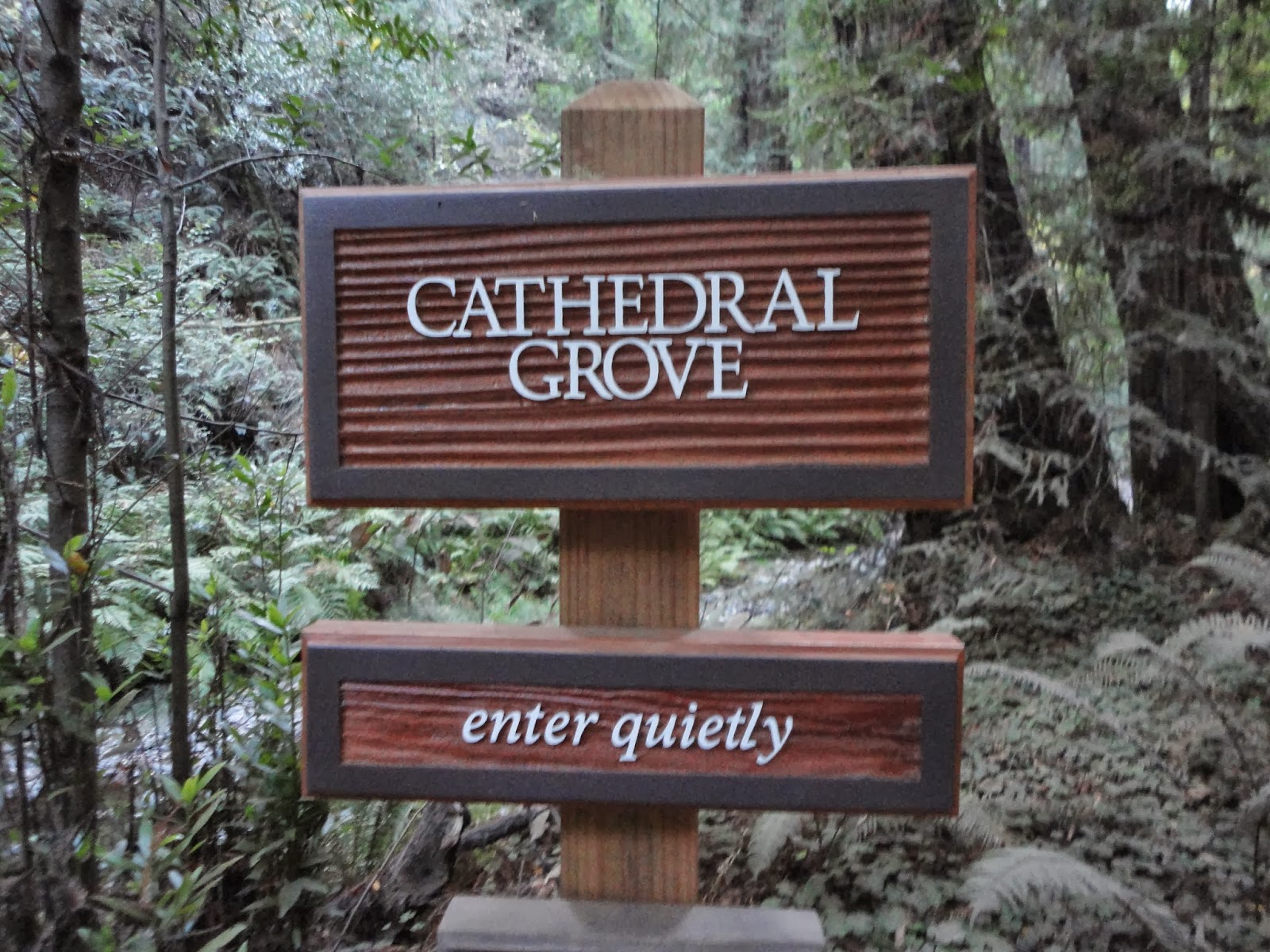
I couldn't think of a more fitting name. The grove did feel like a place of worship.
 
 
In Joanna L Stratton's book, "Pioneer Women: Voices from the Kansas Frontier," Lulu Fuhr observed,
 
"Pioneering is really wilderness experience. We all need the wisdom of the wilderness - Moses did, Jesus did, and Paul did. The wilderness is a place to find God, and the city is the place to study the multitude; a knowledge of both makes for master builders of state and nation."
 
I think our elected leaders should spend more time in these reserves of nature. A colleague returning from a trip to visit the parks in Montana was so moved by what he saw he declared it should be a requirement to go spend time in some of these parks.


Signs everywhere reminded visitors of their impact.
 
 
A godfather of the conservationist movement and Sierra Club founder John Muir. If you haven't already seen it, I highly recommend the Ken Burns documentary, "National Parks: America's Best Idea." I have a large postcard in my home office/library that I framed with Muir's advice:
 
Climb the mountains and get their good tidings.
Feast on sunlight.
Let go of your cares like autumn leaves.
Leave your legacy for the earth
Breath in nature's peace and get their good tidings.
 
 
Sharing one of my favorite poems on trees, by J.J. Brown in her novel American Dream. I feel a bit of Muir's spirit in this work.

“If he could go back in time to when Mother was a child and protect her invisibly throughout her life, he was sure that he would do it. He tried to compose a poem for her during the long ride back.

Let me be a tree.
Let me be the locust tree
her dear hands clasp as a child
where she looks up
as if I were her eternity
And give me a coat of ribbed tree bark
for her to carve her ABC’s.


Let me be a thousand locust blossoms
to perfume her walk in spring
but keep her from the poison seeds
that scatter where she plays.

Or let me be the maple tree
her strong hands tap in spring
and the flowing golden syrup in her glass
then shed the crimson leaves
to line her walk in autumn.

Yes, let me be a tree.
But let me not be hacked into logs
not planed smooth and drowned in stains
not cut by rough hands.

Or if it must be
then let me be the welcome table
laid lovingly with bread by her dear hands.
Let me not fall into disuse, be discarded or burned.

Or if it must be
then let me be the fine smooth boards
that line the coffin where she lays her head
as a final resting place.

Yes, let me be a tree.”

Wednesday, October 31, 2012

These Were My California Storytellers


"Western time now," Laura Ingalls Wilder noted in her letter to husband Almanzo when changing time zones on her train route from her home in Missouri as she documented the journey to visit daughter Rose in San Francisco where the Pan-Pacific International Exhibition was held in 1915. Laura's collection of letters was published in West from Home. Western time it did feel like as well on out honeymoon trip to California. Not just a change in hours but a change in pace, attitude, historical backgrounds shaping our identities and social differences.

Laura, whose Little House series was yet to come, struggled with how often she used the word beautiful in her letters to describe what she saw. Beautiful was a word that I would think of often. During her visit, the city was transformed from the 1906 earthquake and resulting fires that would destroy much of a city that seemed built overnight by the gold rush. Still, there were haunts of the past. Margot Patterson Doss writes in the introduction, "There were occasional vacant lots enclosed by wrought iron fences. In some were marble steps, leading up into thin air. Inez Irwin described them as "a little like meeting a ghost in a crowded street." I felt like I met a lot of ghosts here too.

Natalie Merchant, the upstate New York singer songwriter. Gold Rush Brides, her song with 10,000 Maniacs was with me, but I thought of her observations in "San Andreas Fault," from her first solo album Tigerlily in the context of the dreams the West offered but Mother Nature's harsh realities. I thought of San Francisco, a city built by the riches of gold, destroyed by fire, elemental forces at play.

"San Andreas Fault moved its fingers through the ground.
Earth divided, plates collided, such an awful sound.
San Andreas fault moved its fingers through the ground.
Terra cotta shattered, and the walls came tumbling down.
Oh promise land, what a wicked ground.
Build a dream, tear it down."

With our poorly battered East Coast still reeling from Hurricane Sandy, the duality of nature - its awe-inspiring, nurturing, giving side and its vengeful side - is on my mind. Steve and I lost an old oak tree, but consider ourselves lucky. Still, I think of how the Earth gives, but the Earth takes away.


Naturalist, conservationist, environmentalist, author, an American treasure, the great John Muir, who I knew far too little about until watching Ken Burns' extraordinary series on the National Parks: America's Best Idea, said,

"I only went out for a walk,
and finally concluded to stay out till sundown,
for going out, I found, was really going in."

Much about this trip was indeed about going out, and going in. Going out in Muir Woods not far from the city limits of San Francisco.


The first caretakers, a sign here in Yosemite National Park reminds me .While on this trip, the first presidential and vice presidential debate were held. The environment hasn't gotten a lot of attention, although I'll never understand why clean air, water and soil would ever take a back burner. Where our resources are concerned, I just hear a lot about taking. I liked a quote I read from Robert Redford in a book, "Yosemite Meditations,"

"I think the environment should be put in the category of national security. Defense of our resources is just as important as defense abroad. Otherwise, what is there to defend?"


Seeds of Hope: The California Gold Rush Diary of Susanna Fairchild, by Kristiana Gregory, part of the Dear America series. While this diary was fictional, it gave a fascinating context of true events. Susanna talks of a bear and bull fight at the camps, fights which did take place. An interesting story in the historical notes section,

"The bull and bear fights that took place in early California provided jargon for Wall Street that is still used today. When the animals were brought into the ring, the bear was tethered to a chain. It would dig a hole several inches deep and lie down. From this hole, it would fight, either in prone or sitting position. The bull would stand. Thus, in America's financial centers, a bull market means stocks are going up, and a bear market means stocks are going down." 


At the local bookshop in the gold rush town of Columbia, I picked up A Columbia Diary, the real life diary of Clementine Brainard. I've read a few fictional diaries but this is the first actual diary I read. Clementine wrote in the first entry on October 19, 1853 of her intentions to keep journey during her sea journey but didn't. I brought a diary with me and had romantic notions of keeping it during my trip, and alas was too exhausted to write in it. I consider my blog a bit of a diary, one I haven't felt like writing in as much lately.

Clementine writes, "Do I ever have any thoughts that are worth being transferred to paper? I must be a singular individual.if I do not."

I'm so glad Clementine documented her thoughts, even though yes it feel voyeuristic to read them. Spoiler here if you want to read it yourself.  She writes of her husband's frequent ill health, speaks often about mail deliveries but doesn't elaborate much about what's in the letters, talks often about her faith, and speaks matter-of-factly when talking about death (maybe unsurprisingly seeing how common early death was). She bears her first child with barely any mention before and after of this event. Clementine's husband dies at 30 years of age and she remarries and has six more children, four of whom die in infancy. Walking around an old cemetery in Columbia, one cannot help but think of the hard lives people led and the progresses we made in medical care.


Alice Waters, who founded a national movement for local foods. Julia Child's story has been in my life a lot the last year or two, but what about Alice? Steve and I are still talking about the meal we savored in Berkeley, California at the cafe of Chez Panisse. On many meals on our trip here, we felt like someone just went to their back garden and whipped us up a feast.


Some weren't allowed to tell their stories. Banned books are displayed here at City Lights bookstore in San Francisco. Freedom of speech?


Always on road trips, unexpected storytellers find me, like favorite childhood storyteller Charles Schultz, who has a museum dedicated to him in Santa Rosa. At nearly 37 years of age, I still look forward each year to A Charlie Brown Christmas, and the soundtrack is one of my favorite holiday albums. The visit to the museum was my most charming stop, and how often can one go into a cafe and say with excitement, "One Peppermint Patty hot chocolate, please!" I'm sure somewhere Linus, this Halloween night, is waiting in a patch for the Great Pumpkin, and Mr. Schultz is smiling down on him.